Mastering the Balance The Science Behind Pravegaa’s New Evening + Weekend Learning Cycle (2026 Onwards)
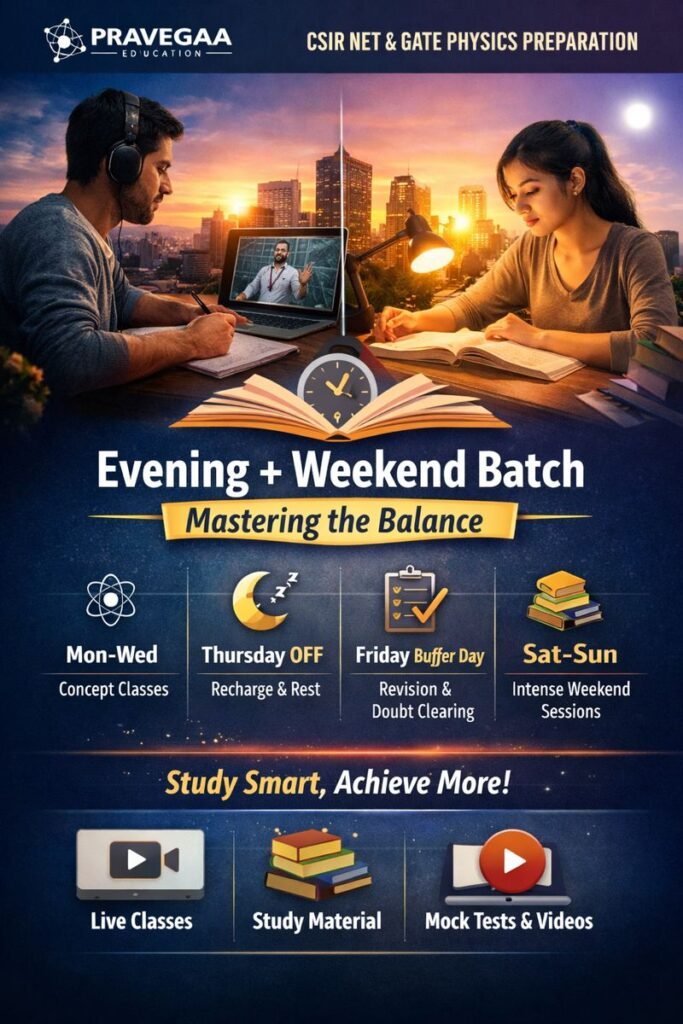
Preparing for high-stakes examinations like CSIR NET Physical Sciences and GATE Physics is often described as a marathon.
But for MSc students and working professionals, it feels more like running a marathon while carrying the full weight of college schedules, jobs, and personal responsibilities.
At Pravegaa Education, we have spent the last three years running one of India’s most successful Evening + Weekend batches—specifically designed for serious aspirants who cannot afford full-day study schedules.
With experience, results, and continuous student feedback, one truth became clear:
Academic excellence alone is not enough.
Learning must respect human energy, psychology, and recovery.
This realization led to the Scientifically Redesigned Evening + Weekend Learning Cycle (2026 onwards).
Why “Hard Work” Alone Isn’t Enough
Success in Physics is not determined by how many hours you study.
It is determined by how efficiently your brain forms, connects, and retains concepts.
Our long-term observations showed that even disciplined and capable students struggled due to:
Physical exhaustion after long college or workdays
Mental fatigue from continuous seven-day schedules
Burnout and loss of motivation due to lack of recovery time
The problem was not dedication.
The problem was an unhealthy learning rhythm.
So instead of pushing students harder, we redesigned the entire learning architecture.
The New Learning Architecture: A Balanced Week
The new Evening + Weekend Batch is structured to keep students academically sharp, mentally fresh, and emotionally supported—without compromising syllabus depth.
1️⃣ The Conceptual Spine (Monday – Wednesday)
The week begins with focused, high-intensity conceptual learning.
Two structured live classes each evening
Core theory, derivations, and guided problem-solving
Evening-only timing, fully compatible with college and job schedules
These three days form the foundation layer of the week—where concepts are built cleanly and systematically.
2️⃣ The Strategic Pause (Thursday – COMPLETE OFF)
Thursday is a mandatory no-class day and a crucial scientific component of the design.
Time for rest, self-study, and backlog clearing
Concepts are allowed to settle and consolidate
Prevents cumulative mental fatigue
Students return on Friday and the weekend refreshed, not drained.
3️⃣ The Shock Absorber & Buffer Day (Friday)
Friday is intentionally kept flexible and acts as a buffer in the learning cycle.
Depending on academic flow and student condition, Friday may be used for:
Revision of difficult or extended topics
Dedicated doubt-clearing sessions
Tests with detailed analysis
Motivational or counselling interactions
Spill-over coverage from the week
Objective:
👉 Zero syllabus pressure
👉 Zero anxiety
4️⃣ The Mastery Phase (Saturday – Sunday)
Weekends are designed for depth, application, and exam maturity.
Saturday: Three structured live classes focused on advanced concepts
Sunday: Three daytime classes (the only daytime sessions of the week)
Weekend focus includes:
Previous Year Questions (PYQs)
Concept synthesis
Exam-oriented problem-solving
This ensures high intensity without exhaustion.
Dedicated Mentor & Counsellor: The Human Layer Behind the Course
Academic structure alone cannot guarantee success—especially for MSc students and working professionals.
That’s why every Evening + Weekend batch is supported by a dedicated mentor and counsellor.
This mentor continuously monitors:
📊 Academic progress: syllabus flow, test trends, conceptual gaps
🧠 Energy & fatigue levels: early burnout detection
💬 Motivation & counselling: support during low phases
🔁 Faculty feedback loop: pace adjustment using the Friday buffer
Because of this system:
Classes remain adaptive, not rigid
Struggles are addressed before they become failures
Students feel guided, supported, and understood—not just taught
This human layer is critical for evening and weekend learners, where energy management matters as much as intellect.
A Complete Preparation Ecosystem
Enrollment in the Evening + Weekend Batch includes a full academic ecosystem:
📘 Soft-copy and hard-copy study material
🎥 Recorded video lectures for revision and backlog control
🧠 Structured notes aligned with CSIR NET & GATE patterns
📊 Regular tests with detailed performance analysis
Learning continuity is never broken—even if a live class is missed.
The “Early Mover” Advantage
Minimum effective duration: 5 months
Strongly recommended: Join 8 months or more before the exam
Why early joining matters:
Calm, pressure-free syllabus coverage
Multiple revision cycles (the real key to top ranks)
Conceptual maturity in demanding subjects like Quantum Mechanics and Statistical Mechanics
Students who join early don’t rush.
They revise, refine, and consolidate.
Final Thought
The journey to becoming a CSIR-NET JRF scholar or a GATE-qualified physicist does not have to be a journey of exhaustion.
At Pravegaa, we believe:
Success comes from studying in the right rhythm—not from studying endlessly.
The new Evening + Weekend Batch is a scientifically engineered learning cycle, strengthened by human mentorship and counselling—balancing rigor, recovery, motivation, and mastery.
If you are serious about Physics and need a schedule that respects both your ambition and your energy,
this course is designed for you.
Pravegaa Education
Your Path to CSIR NET & IIT JAM Success
Frequently Asked Questions (FAQs)
Pravegaa Online Evening + Weekend Batch (CSIR NET & GATE Physics)
1. Who is this batch designed for?
MSc Physics students, working professionals, and serious aspirants who can study mainly in evenings and weekends.
2. How is this different from regular online coaching?
It follows a scientifically designed cycle with evening-only weekdays, a complete off day, a buffer day, and structured weekends—reducing burnout and improving retention.
3. What is the weekday schedule?
Monday–Wednesday: Two evening live classes
Thursday: Complete OFF
Friday: Buffer (revision, doubts, tests, counselling)
4. Why is Thursday completely off?
To allow mental recovery, backlog clearing, and concept consolidation—preventing cumulative fatigue.
5. What is the role of Friday?
A flexible academic support day with zero syllabus pressure.
6. How are weekends structured?
Saturday: Three live classes
Sunday: Three daytime classes focused on PYQs and exam thinking
7. Are recorded lectures available?
Yes. All live classes are recorded for revision and backlog control.
8. What study material is included?
Soft-copy + hard-copy notes aligned with CSIR NET & GATE Physics.
9. What is the minimum course duration?
Minimum effective duration is 5 months; 8 months or more is strongly recommended.
10. Why is early joining recommended?
Because top results come from revision, not rushing.
11. Is this sufficient for both CSIR NET and GATE Physics?
Yes. The curriculum is strategically aligned for both exams.
12. What if I miss a live class?
Watch recordings and use Friday buffer sessions—designed for working students.
13. Are tests included?
Yes, with detailed solutions and performance analysis.
14. Is this suitable for repeaters?
Absolutely. Repeat aspirants benefit most from structured revision and flexible pacing.
15. Who conducts the classes?
All classes are conducted by the experienced faculty team at Pravegaa Education, known for conceptual clarity and exam-oriented teaching.