The Myth of “Studying Hard” for CSIR NET & GATE Physics — And the Hidden Cost of Superficial Preparation By Team Pravegaa Education
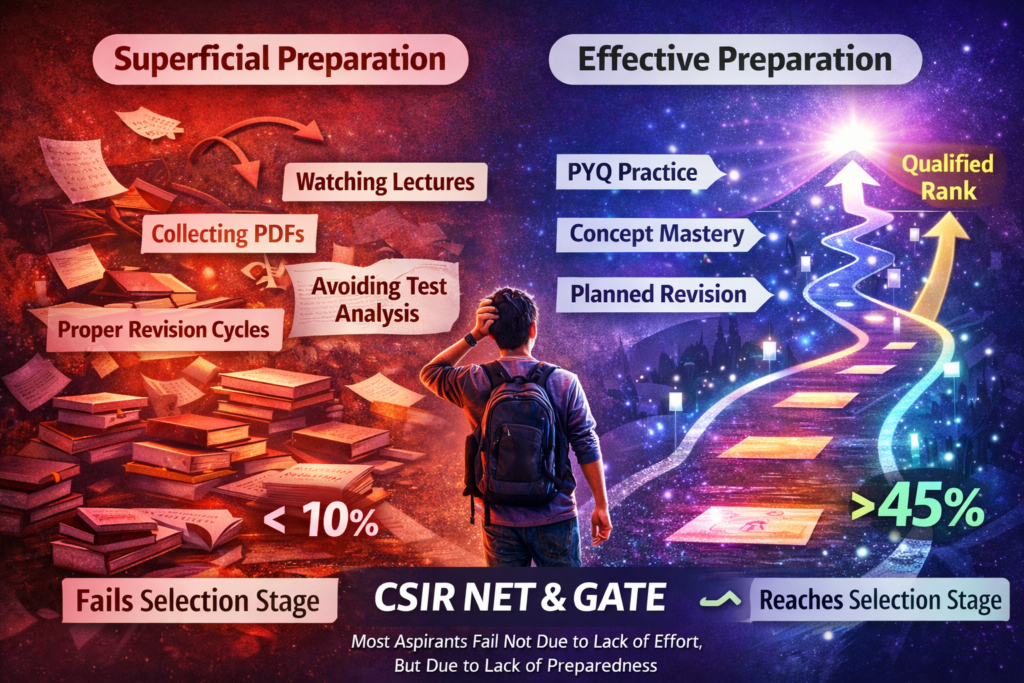
Every year, thousands of physics aspirants sit down at their desks with full intention. They put in long hours. They cover the syllabus. They fill notebooks. They watch lectures. They feel — genuinely feel — that they are working hard enough to qualify CSIR NET or GATE Physics.
And then the results come out. And they are not in the list.
The failure does not happen because they did not study. It happens because of a belief so deeply embedded in Indian exam culture that most aspirants never question it: the belief that more hours of study automatically produce better results.
This belief — that hard work is sufficient — is one of the most expensive myths in physics preparation. And the cost it extracts is not just a failed exam. It is months or years of misdirected effort, repeated attempts, and a slow erosion of confidence in a subject you are genuinely capable of mastering.
What “Studying Hard” Actually Looks Like — and Why It Fails
When most aspirants say they are studying hard, here is what is actually happening:
- Reading through chapters and feeling like the content is making sense
- Watching lecture videos and following the explanations as they are presented
- Highlighting notes and summarising what has been read
- Going through solved examples and understanding the steps as shown
- Accumulating study hours that feel productive because effort is being expended
All of this is effort. None of it reliably produces exam performance. Because what CSIR NET and GATE Physics actually test is not whether you have been exposed to physics — it is whether you can do physics independently, under time pressure, on problems you have never seen before.
The gap between “I have studied this” and “I can solve this” is not closed by more reading. It is closed only by active, unsupported problem solving — and most aspirants who are “studying hard” are almost entirely avoiding it.
What Is Superficial Preparation?
Superficial preparation is preparation that covers the syllabus without building the depth the exam tests. It produces a specific and recognisable profile in every aspirant who falls into it:
- They can recognise a concept when they see it but cannot reproduce it from memory
- They can follow a solution when it is shown but cannot construct one independently
- They feel confident during study sessions but underperform consistently on tests
- They have “covered” the full syllabus but have genuine understanding in only a fraction of it
- They plateau in mock test scores despite continued effort
This is not a character failing. It is a preparation method failing. Superficial preparation feels exactly like real preparation when you are inside it — because the activities involved (reading, watching, noting) are the same. The difference is invisible until the exam reveals it.
Why CSIR NET and GATE Physics Specifically Punish Superficial Preparation
CSIR NET Physical Sciences and GATE Physics are not recall-based examinations. They are designed by researchers to identify students who have genuinely internalised physics — students who can reason from principles, not students who have memorised patterns.
CSIR NET: What It Actually Tests
CSIR NET Part C — the section that separates JRF qualifiers from those who merely pass — consists of complex, multi-step problems that require the integration of multiple concepts across topics. A student who has understood Quantum Mechanics superficially will recognise the type of question but will be unable to construct the solution independently. A student who has developed genuine depth will not only solve it but will understand why each step is necessary.
Part A tests analytical and general reasoning, and Part B tests understanding of core topics at the MCQ level. But it is Part C that determines JRF — and Part C rewards only deep, active knowledge. The proposed 2026 CSIR NET pattern changes, including the introduction of NAT questions, will amplify this further — numerical answer questions eliminate the option of pattern recognition entirely.
GATE Physics: Why Formula Recall Fails
GATE Physics questions are conceptual and application-based. The same formula appears in different contexts, applied to different physical systems, tested at different levels of complexity. A student who has memorised what the formula is will often apply it correctly to familiar problems. The moment the context changes — a slightly different physical setup, a question that requires combining two principles — memorisation fails.
GATE Physics rewards the ability to model physical situations from first principles. This is a skill that only active problem solving develops — and it is precisely the skill that most “hard studying” aspirants have never practised. See Pravegaa’s GATE Physics resources at pravegaa.com/gate for PYQ analysis and topic-wise depth guidance.
The 7 Specific Forms Superficial Preparation Takes
1. Reading as the Primary Study Activity
Reading physics is not the same as doing physics. A textbook read carefully produces familiarity with the material. It does not produce the ability to apply it. For every hour spent reading, at least 40 minutes should be spent attempting unseen problems from that material — with the book closed, no solutions visible, and genuine independent effort before any reference.
2. Watching Solutions Instead of Solving Problems
Solution walkthroughs — whether from a faculty member, a YouTube video, or a coaching recording — are valuable learning tools when used after a genuine attempt. When used as a substitute for attempting the problem, they produce the illusion of skill. The student understands the solution as it is presented but has no idea whether they could have constructed it alone. CSIR NET and GATE exams present problems without walkthroughs.
3. Covering Topics Without Testing Understanding
The most common form of superficial preparation is the race to “complete the syllabus” — moving topic to topic without pausing to test whether each topic has actually been understood. This produces a preparation record that looks impressive (full syllabus covered) but conceals widespread conceptual gaps that only appear under exam conditions.
4. Solving Only Familiar Problem Types
Many aspirants who solve problems consistently solve only the types they already know how to solve. This builds fluency in familiar territory and produces no improvement in the unfamiliar territory that every CSIR NET and GATE paper contains. Deliberate preparation means spending most problem-solving time on question types where errors are frequent — not on types where confidence is already high.
5. Treating PYQs as a Final Revision Activity
Previous year questions are not a revision tool — they are the examiner’s direct communication about what depth is expected. Aspirants who solve PYQs only in the final month of preparation are calibrating to the exam standard too late. PYQs solved topic by topic from the beginning of preparation allow real-time calibration of depth — and identify specific gaps while there is still time to close them. Download free CSIR NET and GATE PYQ papers from Pravegaa’s free study material page.
6. Skipping Error Analysis After Tests
Taking a mock test, checking the score, feeling discouraged or encouraged, and moving on — without understanding why each wrong answer was wrong — is one of the most common ways preparation time is wasted. The analysis session after a test is where improvement actually happens. Error classification (concept gap vs calculation mistake vs question misread vs negative marking error) determines what needs to change before the next test. Aspirants who skip this step repeat the same errors indefinitely. Pravegaa’s CSIR NET Physics Test Series and IIT JAM Test Series both include detailed performance analytics specifically to support this analysis.
7. Mistaking Volume of Material for Depth of Understanding
The aspirant who has read five textbooks on Quantum Mechanics is not necessarily better prepared than the aspirant who has deeply mastered one. CSIR NET and GATE Physics do not reward encyclopaedic exposure — they reward the ability to reason correctly from solid conceptual foundations. One concept understood deeply, with all its implications explored and tested, is worth far more than five concepts understood superficially.
The Hidden Cost of Superficial Preparation
The most visible cost of superficial preparation is a failed exam. But this is rarely the full cost — because the pattern of superficial preparation, once established, typically repeats across multiple attempts. The aspirant who fails CSIR NET because of superficial preparation usually prepares for the next attempt the same way — adding more material to cover, not changing the nature of how they engage with it. The result is the same, or marginally different.
The hidden costs accumulate over repeated cycles:
- Time: Each failed cycle is 6 to 12 months of preparation effort that did not produce the result — and the total across two or three attempts represents years of opportunity cost
- Confidence: Repeated failure despite consistent effort produces a specific kind of self-doubt — the belief that the exam is simply too hard, or that you are not capable, rather than the accurate diagnosis that your preparation method needs to change
- Career trajectory: Every delayed qualification is a delayed PhD admission, delayed fellowship access, delayed research career entry — compounding consequences that follow a single systemic preparation error
- Compounding gaps: Superficial preparation builds on itself. Unresolved conceptual gaps in early topics compound into wider gaps in advanced topics, making each subsequent preparation cycle harder to execute well without targeted remediation
What Deep Preparation Looks Like Instead
Deep preparation is not about studying more hours. It is about changing the nature of what happens during those hours. Here is what it looks like in practice:
Active Problem Solving as the Core Activity
For every concept studied, at least 60% of the associated time should be spent solving problems independently — without looking at solutions, without open textbooks, under mild time pressure that simulates exam conditions. This is the only activity that builds the problem-solving reflex that CSIR NET and GATE test.
Verification of Understanding Before Moving Forward
Before advancing to the next topic, verify that the current one is genuinely understood: close all materials and attempt to derive the key results from memory, explain the physical meaning in plain language, and solve 3 to 5 unseen problems correctly. If this is not possible, the topic is not ready — and the next topic will be proportionally weaker as a result.
PYQ Integration from Day One
Previous year questions from CSIR NET and GATE Physics should be solved alongside each topic — not after the full syllabus is covered. This provides continuous calibration against the actual exam standard and identifies depth gaps in real time. The complete syllabus for CSIR NET and GATE Physics, with topic-wise PYQ guidance, is available at pravegaa.com/syllabus.
Structured Test-Analyse-Fix Cycles
Regular topic-wise and full-length tests, followed by systematic error analysis and targeted remediation of each identified gap. This cycle — test, analyse, classify error, fix at root, retest — is what converts effort into improvement. Without it, test-taking produces data that is never acted upon.
Doubt Resolution at the Point of Confusion
Every doubt deferred is a gap that compounds. Deep preparation requires resolving each conceptual confusion before advancing — through faculty consultation, targeted textbook review, or mentor guidance. At Pravegaa, doubt resolution is a structural component of every programme — not an optional extra. You can explore Pravegaa’s teaching philosophy and see why concept-first preparation with active doubt resolution is at the core of how preparation is structured.
How to Audit Whether Your Preparation Is Superficial
Apply this honest audit to your current preparation:
- For any topic you have “covered” — can you derive the key results from memory without any reference?
- When you encounter an unseen problem type in a topic you have studied — can you construct a solution independently?
- After a mock test — do you analyse every wrong answer by error type, or do you check the score and move on?
- In your daily preparation — what percentage of time is active problem solving vs. reading or watching?
- Do you solve PYQs topic by topic as you study, or are you saving them for later?
- When you have a doubt — is it resolved that day, or does it go into a list that grows without resolution?
Honest answers to these questions will tell you whether your preparation is producing depth or accumulating surface coverage. If the answers reveal superficial patterns — the solution is not to study more hours. It is to change what happens during those hours.
Frequently Asked Questions
I have been preparing for 2 years and still not qualifying CSIR NET. What is going wrong?
Two years of preparation without qualification is almost always a method problem, not an ability problem. The most likely causes: preparation is primarily passive (reading and watching rather than solving), doubts are being carried forward unresolved, PYQs are not being integrated from the start, and error analysis after tests is not happening systematically. An honest audit of how those two years were spent — not how many hours, but what the hours contained — will identify the specific failures. Then change the method before adding more time.
How much of my study time should be active problem solving vs. reading?
For CSIR NET and GATE Physics preparation at an intermediate to advanced stage, approximately 60 to 70% of study time should be active problem solving — unseen problems, attempted independently, without reference. Reading and concept review should comprise the remaining 30 to 40%. Most aspirants who are underperforming have this ratio reversed: they spend 70 to 80% of their time reading and watching, and 20 to 30% solving problems — and usually only solving familiar problem types.
Is CSIR NET Physics genuinely difficult, or is it a preparation quality problem?
Both, to different degrees. CSIR NET is genuinely conceptually demanding — the Part C questions are designed to test research-level understanding and require deep mastery of core physics. But the majority of aspirants who do not qualify are not failing because the exam is too hard — they are failing because their preparation method does not build the depth the exam requires. The exam is hard; superficial preparation makes it much harder than it needs to be.
Does coaching help with this, or is the problem in the student’s study habits?
A good coaching programme addresses both simultaneously. It structures the preparation to prevent superficial habits from forming — through active problem-solving sessions, regular assessment, mandatory doubt resolution, and mentor accountability. Without coaching, the default tendency for most aspirants is to drift toward passive, comfortable study. A structured programme makes deep preparation the path of least resistance rather than requiring the student to impose that discipline entirely alone. See Pravegaa’s results for what structured, depth-first preparation produces when applied consistently.
How does the proposed new CSIR NET pattern make superficial preparation even riskier?
The proposed 2026 CSIR NET pattern changes include the introduction of Numerical Answer Type (NAT) questions — questions where you must compute and type the exact answer, with no options to guide you. NAT questions completely eliminate the possibility of pattern recognition or educated guessing. They test only one thing: whether you can solve the problem correctly from first principles. Aspirants who have prepared superficially — recognising patterns rather than building genuine calculation ability — will find NAT questions particularly damaging. Read the full analysis at Pravegaa’s CSIR NET 2026 pattern analysis.
The Pravegaa Approach: Depth Over Coverage
Pravegaa Education was founded on the explicit rejection of the shortcut-based, surface-coverage approach to physics preparation. India has no shortage of talented physics students. What it often lacks is a preparation ecosystem that respects the intellectual depth of physics — that treats CSIR NET, GATE, IIT JAM, JEST, and TIFR as what they are: research-level assessments that reward genuine understanding, not exam-oriented tricks.
Pravegaa’s programmes are built around a single principle: one concept understood deeply is worth more than ten concepts understood superficially. Every class, every problem set, every test, every doubt resolution session is designed to build depth — not coverage. This is why Pravegaa’s results include multiple AIR 1 outcomes and 8,000+ selections across 15+ years: not because students were pushed harder, but because they were prepared differently.
Change the Method. Not the Hours.
If you are studying hard and not qualifying, the answer is not to study harder. It is to study differently — with active problem solving at the centre, PYQ integration from the start, systematic error analysis after every test, and doubt resolution as a structural habit rather than an afterthought.
The exam is not too hard for you. The preparation method is not working hard enough.
Explore Pravegaa’s resources to build the kind of preparation that actually produces results:
- CSIR NET & IIT JAM Online Live Course — concept-first live preparation with active problem solving, PYQ-driven sessions, and real-time doubt resolution
- CSIR NET Physics Test Series — structured All India Test Series with full error analysis, performance analytics, and rank benchmarking
- IIT JAM Physics Test Series — All India Rank, topic-wise and full mock exams with detailed conceptual solutions
- Free Physics Study Material — topic-wise PDFs, PYQ papers, and formula sheets for CSIR NET and GATE Physics
- Physics Exam Syllabus — complete CSIR NET, GATE, IIT JAM, JEST, and TIFR syllabus with preparation guidance
- GATE Physics Resources — previous year papers, analysis, and preparation strategy for GATE Physics
- CSIR NET 2026 Pattern Analysis — complete breakdown of proposed pattern changes and what aspirants must do now
- All Pravegaa Courses — full range of programmes for CSIR NET, IIT JAM, GATE, JEST, and TIFR Physics