IIT JAM Physics Syllabus: Your Ultimate Study Guide for Success
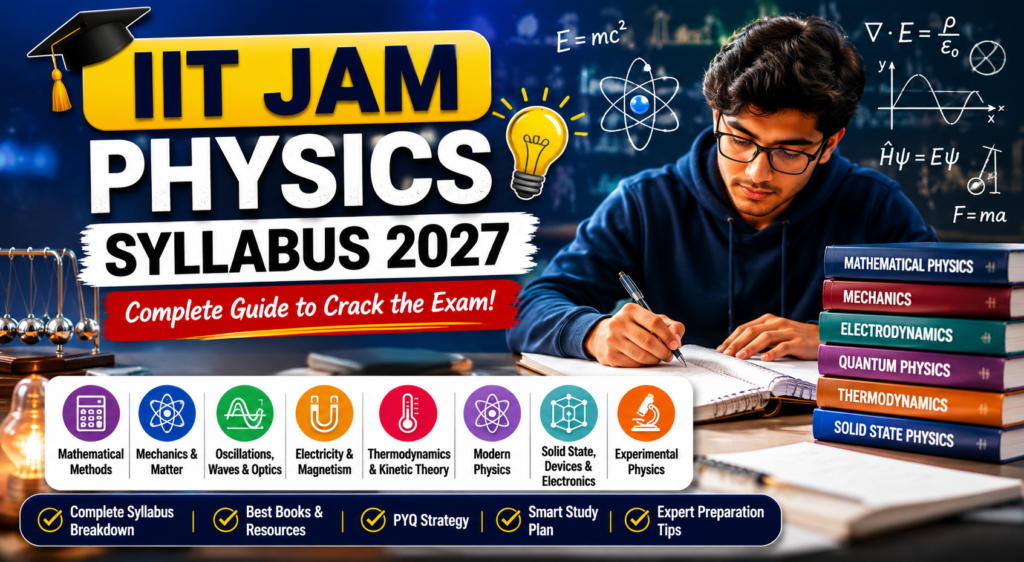
The IIT JAM Physics syllabus is the single most important document for any BSc Physics student aiming for an M.Sc. seat at an IIT. It tells you exactly what to study, how deep to go, and where to focus your energy across 12+ months of preparation.
In this guide, we break down every topic in the IIT JAM Physics syllabus — with study strategies, recommended books, and expert tips from the faculty at Pravegaa Education who have helped hundreds of students crack JAM with top ranks.
Whether you are just starting out or are in the final months of preparation, bookmark this page — it will serve as your master reference throughout your journey.
Table of Contents
- Overview of the IIT JAM Physics Syllabus
- Core Topics at a Glance
- Mathematical Methods
- Mechanics and General Properties of Matter
- Oscillations, Waves and Optics
- Electricity and Magnetism
- Kinetic Theory and Thermodynamics
- Modern Physics
- Solid State Physics, Devices and Electronics
- Experimental Physics
- Recommended Books and Resources
- Study Strategies
- Importance of Previous Year Question Papers
- Time Management Tips
- Common Mistakes to Avoid
- Final Thoughts
Overview of the IIT JAM Physics Syllabus
The Indian Institutes of Technology Joint Admission Test for M.Sc. (IIT JAM) is one of the most competitive postgraduate entrance examinations in India. Among all subjects, Physics demands the widest syllabus and the deepest conceptual grounding.
The IIT JAM Physics syllabus is designed to test both conceptual clarity and advanced problem-solving ability — two pillars that define a good physicist. Topics range from Classical Mechanics to Modern Physics, covering virtually every branch of undergraduate physics.
Understanding the syllabus in full is your first step. The second step is structured preparation under expert guidance. If you haven’t already explored our IIT JAM Physics coaching programmes, check them out to see how we cover the entire syllabus systematically through our Five Stage Learning Model.
Core Topics in the IIT JAM Physics Syllabus
The IIT JAM Physics syllabus covers the following major areas:
- Mathematical Methods
- Mechanics and General Properties of Matter
- Oscillations, Waves and Optics
- Electricity and Magnetism
- Kinetic Theory and Thermodynamics
- Modern Physics
- Solid State Physics, Devices and Electronics
- Experimental Physics
Each area is interrelated. A strong understanding of Mathematical Methods, for example, directly accelerates your learning in Quantum Mechanics, Electrodynamics, and Thermodynamics. We will cover each area in detail below.
Pravegaa Insight: Students who build strong fundamentals in Mathematical Methods and Classical Mechanics early in their preparation find the rest of the syllabus significantly easier to absorb. Do not rush past the foundations.
Mathematical Methods
Mathematical Methods are the language of physics. Without a firm grip here, every other topic becomes unnecessarily difficult.
Key Topics
- Calculus — partial derivatives, multiple integrals, line and surface integrals
- Vector Calculus — gradient, divergence, curl, Stokes’ and Gauss’s theorems
- Linear Algebra — matrices, determinants, eigenvalues and eigenvectors
- Differential Equations — ODEs and PDEs commonly appearing in physics
- Complex Analysis — analytic functions, contour integrals
- Fourier series and transforms
What to Focus On
Prioritise vector calculus and differential equations — they appear repeatedly across Electrodynamics, Quantum Mechanics, and Classical Mechanics. A weak foundation here creates a cascading problem across the entire syllabus.
Access our free Mathematical Physics formula sheets and concept notes to supplement your textbook study.
Mechanics and General Properties of Matter
Classical Mechanics forms the conceptual backbone of physics. IIT JAM tests this topic at a fairly advanced level — well beyond standard BSc textbook problems.
Key Topics
- Newton’s Laws and their applications
- Work-Energy Theorem, Conservation of Momentum and Energy
- Rotational Dynamics — angular momentum, moment of inertia
- Gravitation and central force problems
- Fluid Mechanics — viscosity, Bernoulli’s theorem
- Elasticity — stress, strain, Young’s modulus
- Non-inertial frames — pseudo-forces, Coriolis effect
What to Focus On
Problems from rotational dynamics and conservation laws appear frequently. Practice using both Cartesian and polar coordinate systems fluently. Non-inertial frames are a high-yield topic that many students underestimate.
Oscillations, Waves and Optics
This section bridges Classical Mechanics and Modern Physics, testing your ability to analyse wave behaviour mathematically and physically.
Key Topics
- Simple Harmonic Motion — equations of motion, energy
- Damped and Forced Oscillations — resonance, Q-factor
- Coupled Oscillations — normal modes
- Wave Equation — transverse and longitudinal waves
- Interference, Diffraction, Polarisation
- Geometric Optics — mirrors, lenses, prisms
- Wave Optics — Young’s double slit, single slit diffraction, diffraction gratings
What to Focus On
Normal mode analysis and wave superposition problems are JAM favourites. For optics, ensure you are comfortable deriving interference conditions from first principles — not just remembering final formulas.
Electricity and Magnetism
Electricity and Magnetism (Electrodynamics) is one of the most heavily weighted sections in IIT JAM Physics. Expect 5–8 questions from this area in every paper.
Key Topics
- Electrostatics — Coulomb’s law, Gauss’s law, electric potential
- Conductors, dielectrics, capacitance
- Magnetostatics — Biot-Savart law, Ampere’s law, magnetic vector potential
- Electromagnetic Induction — Faraday’s law, Lenz’s law
- Maxwell’s Equations and Electromagnetic Waves
- AC circuits — LCR circuits, impedance, resonance
What to Focus On
Maxwell’s equations in both integral and differential form must be at your fingertips. Practice deriving the wave equation from Maxwell’s equations. Boundary condition problems — for E and B fields at interfaces — are high-frequency JAM questions.
Pravegaa Tip: Griffiths’ Introduction to Electrodynamics remains the gold standard for this section. Our faculty at Pravegaa use it as the primary reference for all Electrodynamics sessions.
Kinetic Theory and Thermodynamics
This section tests your understanding of macroscopic physical behaviour — heat, temperature, entropy, and the statistical basis of thermodynamics.
Key Topics
- Kinetic Theory of Gases — Maxwell-Boltzmann distribution, mean free path
- Laws of Thermodynamics — Zeroth, First, Second, Third
- Entropy — statistical interpretation, Clausius inequality
- Thermodynamic Potentials — G, F, H, and their Maxwell relations
- Heat Engines and Refrigerators — Carnot cycle, efficiency
- Phase Transitions — Clausius-Clapeyron equation
What to Focus On
Maxwell relations and their derivations are must-know derivations for JAM. The Carnot cycle and efficiency problems appear almost every year. Practice deriving thermodynamic identities from the four potentials systematically.
This topic overlaps significantly with CSIR NET Statistical Mechanics, making it doubly important for students who plan to attempt both exams.
Modern Physics
Modern Physics brings in Quantum Mechanics, Atomic Physics, and Nuclear Physics — the frontier where classical intuition fails and mathematical rigour is non-negotiable.
Key Topics
- Wave-Particle Duality — de Broglie hypothesis, photoelectric effect, Compton scattering
- Schrödinger Equation — time-dependent and time-independent forms
- Particle in a Box, Harmonic Oscillator, Hydrogen Atom
- Quantum States, Wave Functions, Probability Density
- Atomic Physics — Bohr model, spectral series, spin
- Nuclear Physics — radioactive decay, nuclear reactions, binding energy
- Special Relativity — Lorentz transformation, mass-energy equivalence
What to Focus On
The Schrödinger equation and its solutions for standard potentials are absolute must-knows. Quantum Mechanics is also the most conceptually rich section — rote memorisation will not work here. Focus on understanding why the mathematics works the way it does.
Our faculty teach Quantum Mechanics using a research-oriented approach — the same rigorous framework used in top universities. Learn more about our IIT JAM Physics programme to see how we handle this topic.
Solid State Physics, Devices and Electronics
This section combines material science fundamentals with practical electronics — an area that many students neglect but which consistently delivers marks in JAM.
Key Topics
- Crystal Structure — Bravais lattices, Miller indices, reciprocal lattice
- Band Theory of Solids — Bloch theorem, energy bands, effective mass
- Semiconductor Physics — intrinsic and extrinsic semiconductors, carrier concentration
- p-n Junction — diode characteristics, rectification
- Transistors — BJT, FET, amplifier circuits
- Operational Amplifiers — inverting, non-inverting, integrator, differentiator
- Digital Electronics — logic gates, Boolean algebra
What to Focus On
Crystal structure and band theory problems are JAM staples. For electronics, focus on op-amp circuits and transistor biasing — these are high-yield, relatively straightforward marks if you practice regularly.
Experimental Physics
Experimental Physics is often underestimated by students, but it tests a fundamental skill: the ability to think critically about measurements, errors, and experimental design.
Key Topics
- Measurement Techniques — vernier, screw gauge, spectrometer
- Error Analysis — systematic and random errors, propagation of errors
- Statistical Methods — mean, standard deviation, Gaussian distribution
- Dimensionless Analysis
- Data Interpretation — graphical methods, least squares fitting
What to Focus On
Error propagation — how errors combine in addition, multiplication, and power functions — appears in nearly every JAM paper. Master this topic thoroughly. It requires minimal effort but offers reliable marks.
Recommended Books for IIT JAM Physics
Here is a topic-wise list of the most effective books for IIT JAM Physics preparation:
| Topic | Recommended Books |
|---|---|
| Mathematical Methods | Arfken & Weber; Mary L. Boas |
| Classical Mechanics | Herbert Goldstein; D.S. Mathur |
| Oscillations, Waves & Optics | N.K. Bajaj; Ajoy Ghatak |
| Electricity & Magnetism | Griffiths; Purcell |
| Thermodynamics | Zemansky & Dittman; Kittel & Kroemer |
| Modern Physics / QM | Griffiths (QM); Beiser (Modern Physics) |
| Solid State Physics | Charles Kittel |
| Electronics | Boylestad & Nashelsky |
| Experimental Methods | John R. Taylor (Error Analysis); G.L. Squires |
In addition to textbooks, our free resources section offers concept notes, formula sheets, and topic-wise video lectures that are specifically tailored to the JAM exam pattern — helping you study smarter, not harder.
Effective Study Strategies for IIT JAM Physics
1. Create a Realistic Study Plan
Divide the syllabus into monthly, weekly, and daily targets. Start with foundational topics (Mathematical Methods, Mechanics) in the first phase, then advance to Modern Physics and Solid State in later months. Allocate revision weeks at the end of each month.
2. Prioritise Conceptual Understanding Over Rote Learning
IIT JAM is not a memory test. Examiners design problems to check whether you truly understand the physics. Always ask “why does this work?” before moving to “how do I apply this?”
This is the teaching philosophy at Pravegaa Education — our Five Stage Learning Model ensures students build genuine understanding at every step.
3. Solve Problems Daily — Without Exception
Physics is learnt through doing, not reading. Solve at minimum 10–15 problems per day across different topics. Use both your textbooks and previous year question papers as problem sources.
4. Use Topic-Wise Tests to Identify Gaps
After completing each topic, take a timed topic test. This reveals gaps in understanding before they accumulate. Our IIT JAM Physics Test Series is structured exactly this way — topic tests followed by full-length mock exams that simulate the actual paper.
5. Revise Regularly
The human brain forgets material that isn’t revisited. Build revision into your weekly schedule. Create brief formula sheets and concept summaries for each topic so revision takes minutes, not hours.
6. Form or Join a Study Group
Explaining concepts to peers is one of the fastest ways to deepen understanding. If you are preparing in isolation, our live online batches at Pravegaa provide a collaborative learning environment with direct access to faculty for doubt resolution.
Why Previous Year Question Papers Are Non-Negotiable
If there is one study resource that outperforms all others in JAM preparation, it is the previous year question papers (PYQs). Here is why:
They Reveal the Actual Exam Pattern
JAM has three sections: Section A (MCQs), Section B (MSQs), and Section C (NAT — numerical answer type). PYQs show you exactly how each section is structured, how marks are distributed, and which topics dominate the paper.
They Identify High-Frequency Topics
Certain topics appear in almost every JAM paper. Analysing 10 years of papers reveals these patterns clearly. You can then prioritise high-frequency topics in your preparation to maximise your score.
They Build Exam Temperament
Solving PYQs under timed conditions trains you to handle exam pressure. Most students who struggle in the actual exam do so not because of knowledge gaps but because of poor time distribution. Regular PYQ practice eliminates this problem.
Download IIT JAM Physics previous year papers from our free resources section and begin solving them from Day 1 of your preparation — not just in the final weeks.
Pravegaa Recommendation: Solve at least the last 10 years of IIT JAM Physics papers. After solving, analyse each wrong answer in detail — understanding why you went wrong is more valuable than the solving itself.
Time Management Tips for IIT JAM Physics Preparation
- Set daily micro-goals: Instead of “study physics today,” set goals like “complete 3 problems on normal modes and revise Maxwell’s equations.” Specificity drives execution.
- Use the Pomodoro Technique: 25 minutes of focused study, 5 minutes rest. After 4 cycles, take a 20-minute break. This prevents mental fatigue during long study sessions.
- Allocate time by topic weightage: Give more hours to Electrodynamics, Quantum Mechanics, and Thermodynamics — these three areas alone account for 40–50% of the JAM paper.
- Protect your morning hours: Cognitive performance is highest in the morning. Use this time for new and difficult material; use evenings for revision and easier problems.
- Track your weekly progress: At the end of each week, assess what you completed vs. what you planned. Adjust next week’s targets accordingly.
- Eliminate phone distractions: Social media is the silent killer of physics preparation. Use app blockers during study sessions without exception.
Common Mistakes IIT JAM Aspirants Make (and How to Avoid Them)
1. Skipping Mathematical Methods
Many students treat this as an optional topic. It is not. Every topic downstream — QM, EM, Thermodynamics — is built on Mathematical Methods. Invest 3–4 weeks here at the beginning of your preparation.
2. Memorising Formulas Without Understanding Derivations
JAM questions are deliberately designed to trip up students who only know the final formula. Know where every important result comes from. Derivations appear in Section B and C regularly.
3. Ignoring Experimental Physics
This section appears simple but students lose easy marks by neglecting error analysis. A few hours of focused study here can yield disproportionate marks in the exam.
4. Not Attempting Mock Tests Early Enough
Mock tests should begin well before the exam — not in the final week. Our IIT JAM Test Series provides 15+ full-length mocks and 30+ topic tests to give you ample practice from early in your preparation.
5. Preparing in Isolation Without Feedback
Physics preparation without expert feedback leads to compounding errors. If a misconception is not corrected early, it creates cascading problems across related topics. This is why mentored preparation — as offered in our live online coaching programme — significantly outperforms purely self-study approaches.
6. Neglecting Physical and Mental Health
Sleep deprivation directly impairs memory consolidation and problem-solving ability. A student who sleeps 7–8 hours and studies 8 focused hours will consistently outperform one who sleeps 5 hours and “studies” 12 fragmented hours.
Final Thoughts: Your Path to IIT JAM Physics Success
The IIT JAM Physics syllabus is extensive — but it is entirely conquerable with the right strategy, consistent effort, and expert guidance. The students who succeed are not necessarily the most gifted; they are the ones who build genuine conceptual depth, practise relentlessly, and course-correct quickly when they go wrong.
At Pravegaa Education, we have helped hundreds of students navigate this exact journey — from foundational confusion to confident exam performance. Our faculty — Atul Gaurav (JNU) and Dr. Alok Shukla (IIT Delhi) — bring both academic rigour and real exam understanding to every session.
Here is what we recommend as your next step:
- 📥 Download our free IIT JAM Physics resources — previous year papers, formula sheets, and concept notes
- 📋 Attempt a free topic test to assess your current level
- 📞 Talk to our counsellors to find the right programme for your timeline and goals
- 🎓 Explore our IIT JAM Physics courses — online live, offline, and recorded options available
Your IIT dream is achievable. The syllabus is clear. The path is laid out. All that remains is the decision to begin — and to begin well.
For enquiries: Call us at 8920759559 or 8076563184, or visit www.pravegaa.com.
Also read: