IIT JAM Physics 2027 Complete Syllabus – Topic-wise Weightage and What to Study First

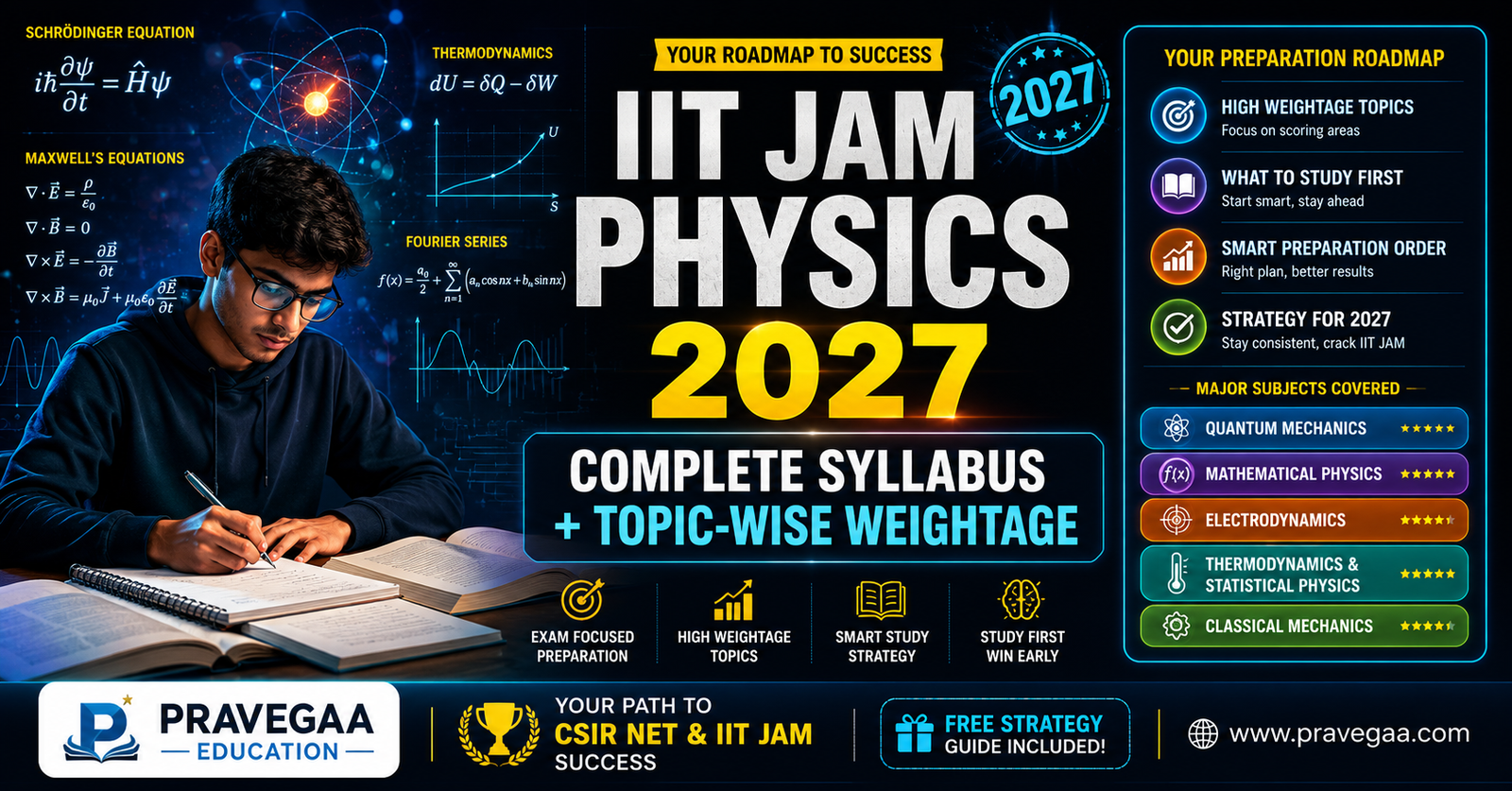
Focused student studying for IIT JAM Physics 2027 with glowing physics equations, topic-wise syllabus roadmap, and preparation strategy by Pravegaa Education.


https://www.pravegaa.com Your Path to CSIR NET and IIT JAM Success Thu, 21 May 2026 06:00:00 +0000 en-US 1.2 https://pravegaa.com https://pravegaa.com 1

By Pravegaa Education | Updated: May 2026 | Reading Time: 12 minutes

/wp:paragraph wp:quote

Quick Summary: IIT JAM Physics 2027 covers 8 major units tested across 60 questions (100 marks) in a 3-hour computer-based exam. Mathematical Physics, Electrodynamics, and Quantum Mechanics together account for nearly 45% of the paper. This guide gives you the complete syllabus, topic-wise weightage based on PYQ analysis, and a prioritised study sequence — so you know exactly what to study first.

/wp:quote wp:heading {“level”:2}

Table of Contents

/wp:heading wp:list {“ordered”:true}

  1. What is IIT JAM Physics 2027?
  2. Exam Pattern at a Glance
  3. Complete Syllabus — All 8 Units
  4. Topic-wise Weightage (Based on PYQ Analysis)
  5. What to Study First — Priority Order
  6. Unit-wise Preparation Strategy
  7. Recommended Books for Each Topic
  8. Common Mistakes That Drop Your Rank
  9. How Pravegaa Structures Your IIT JAM Preparation
  10. Frequently Asked Questions

/wp:list wp:separator


/wp:separator wp:heading {“level”:2}

What is IIT JAM Physics 2027?

/wp:heading wp:paragraph

IIT JAM (Joint Admission Test for M.Sc.) is a national-level entrance exam conducted by the IITs for admission to M.Sc. Physics, Joint M.Sc.-Ph.D., and other postgraduate science programmes at IITs and IISc.

/wp:paragraph wp:paragraph

For IIT JAM 2027, the exam is expected to be held in February 2027, with registrations opening in September 2026. Over 85,000 candidates compete annually for approximately 800 seats in IIT Physics programmes — making it one of the most competitive postgraduate science entrances in India.

/wp:paragraph wp:paragraph

Why IIT JAM Physics matters:

/wp:paragraph wp:list

  • Gateway to M.Sc. Physics at IIT Bombay, IIT Delhi, IIT Kanpur, IIT Madras, IIT Roorkee, IISc, and more
  • Mandatory qualifier for CSIR JRF, GATE Physics, JEST, and TIFR in many programme pipelines
  • Builds the exact conceptual foundation needed for a research career in physics

/wp:list wp:quote

Are you a BSc Physics student in 2nd or 3rd year? The best time to start is now. Explore Pravegaa’s IIT JAM Physics Course →

/wp:quote wp:separator


/wp:separator wp:heading {“level”:2}

IIT JAM Physics 2027 Exam Pattern at a Glance

/wp:heading wp:table

ParameterDetails
ModeComputer-Based Test (CBT)
Duration3 Hours
Total Questions60
Total Marks100
Section A30 MCQs — 1 or 2 marks each
Section B10 MSQs — 2 marks each (no negative marking)
Section C20 NAT questions — 1 or 2 marks each (no negative marking)
Negative MarkingOnly in Section A: -1/3 for 1-mark, -2/3 for 2-mark wrong answers
MediumEnglish only

/wp:table wp:paragraph

Key insight: Section C (NAT) is where most students lose marks. There are no options — you must calculate the exact numerical answer. This is precisely why Pravegaa’s teaching focuses on deep understanding, not formula memorisation.

/wp:paragraph wp:separator


/wp:separator wp:heading {“level”:2}

IIT JAM Physics 2027 Complete Syllabus — All 8 Units

/wp:heading wp:paragraph

The IIT JAM Physics syllabus is divided into 8 major units. Here is the complete topic breakdown:

/wp:paragraph wp:heading {“level”:3}

Unit 1 — Mathematical Physics

/wp:heading wp:list

  • Calculus of single and multiple variables
  • Partial derivatives, Jacobian, Taylor expansion, Fourier series
  • Vector algebra and Vector Calculus
  • Multiple integrals, Divergence theorem, Green’s theorem, Stokes’ theorem
  • First order and linear second-order differential equations with constant coefficients
  • Matrices and determinants
  • Complex numbers (Euler’s equation, De Moivre’s theorem, hyperbolic functions)
  • Error analysis — significant figures, types of errors, mean, median, standard deviation

/wp:list wp:paragraph

Standard textbooks: Arfken & Weber, H.K. Dass

/wp:paragraph wp:heading {“level”:3}

Unit 2 — Mechanics and General Properties of Matter

/wp:heading wp:list

  • Newton’s laws of motion and applications
  • Velocity and acceleration in Cartesian, polar, and cylindrical coordinates
  • Uniformly rotating frame, centrifugal and Coriolis forces
  • Motion under central force, Kepler’s laws
  • System of particles — centre of mass, equations of motion
  • Conservation laws — energy, momentum, angular momentum
  • Elastic and inelastic collisions
  • Rigid body motion — moment of inertia, parallel and perpendicular axes theorems
  • Fluid mechanics — Pascal’s law, Stokes’ law, Bernoulli’s equation
  • Gravitation and gravitational potential energy
  • Elastic properties — Hooke’s law, Young’s modulus, bulk modulus, rigidity modulus
  • Special Theory of Relativity — Lorentz transformations, relativistic kinematics, mass-energy equivalence

/wp:list wp:paragraph

Standard textbooks: Kleppner & Kolenkow, A.B. Gupta

/wp:paragraph wp:heading {“level”:3}

Unit 3 — Oscillations, Waves and Optics

/wp:heading wp:list

  • Differential equation of simple harmonic oscillator
  • Damped and forced oscillations — resonance
  • Superposition of harmonic oscillations
  • Wave equation — travelling and standing waves
  • Phase and group velocity
  • Sound waves and Doppler effect
  • Fermat’s principle
  • Reflection, refraction, interference (Young’s double slit, Lloyd’s mirror, thin film)
  • Fraunhofer diffraction — single slit, double slit, diffraction grating
  • Rayleigh criterion, polarisation — Brewster’s angle, Malus’s law

/wp:list wp:paragraph

Standard textbooks: H.C. Verma (Concepts of Physics), A.B. Gupta

/wp:paragraph wp:heading {“level”:3}

Unit 4 — Electricity and Magnetism

/wp:heading wp:list

  • Coulomb’s law, Gauss’s law, electric field and potential
  • Poisson’s and Laplace’s equations
  • Conductors, capacitors, dielectrics
  • Biot-Savart law, Ampere’s law, magnetic field and force
  • Faraday’s law, Lenz’s law, self and mutual inductance
  • AC circuits — LCR circuits, resonance, quality factor, power factor
  • Electromagnetic induction
  • Maxwell’s equations in free space and in media
  • Electromagnetic waves — wave equation, Poynting vector, energy density

/wp:list wp:paragraph

Standard textbooks: Griffiths (Introduction to Electrodynamics) — the gold standard for JAM

/wp:paragraph wp:heading {“level”:3}

Unit 5 — Kinetic Theory and Thermodynamics

/wp:heading wp:list

  • Elements of kinetic theory of gases
  • Velocity distribution — Maxwell-Boltzmann
  • Mean free path, viscosity, conductivity, diffusion
  • Equipartition theorem and its applications
  • Laws of thermodynamics — first, second, and third law
  • Work and heat — thermodynamic processes
  • Carnot engine, efficiency, reversibility
  • Entropy — concept and applications
  • Thermodynamic potentials — free energy, enthalpy, Gibbs free energy
  • Maxwell thermodynamic relations
  • Phase transitions — Clausius-Clapeyron equation
  • Van der Waals equation

/wp:list wp:paragraph

Standard textbooks: Zemansky & Dittman, F.W. Sears

/wp:paragraph wp:heading {“level”:3}

Unit 6 — Modern Physics

/wp:heading wp:list

  • Blackbody radiation and Planck’s hypothesis
  • Photoelectric effect and Compton effect
  • Bohr’s atomic model, hydrogen spectrum
  • Wave-particle duality — de Broglie waves, Davisson-Germer experiment
  • Uncertainty principle (Heisenberg)
  • Nuclear physics — binding energy, radioactive decay, nuclear reactions
  • Fission and fusion (qualitative)
  • Nuclear models — liquid drop model, magic numbers
  • X-ray spectrum — Moseley’s law, characteristic and continuous X-rays
  • Laser — basic principles, population inversion

/wp:list wp:paragraph

Standard textbooks: Krane (Modern Physics), Beiser

/wp:paragraph wp:heading {“level”:3}

Unit 7 — Solid State Physics, Devices and Electronics

/wp:heading wp:list

  • Crystal structure — Bravais lattices, Miller indices, X-ray diffraction
  • Bragg’s law
  • Bonding in solids
  • Free electron theory, band structure, metals, semiconductors, insulators
  • Intrinsic and extrinsic semiconductors
  • p-n junction, diodes — characteristics, rectifiers
  • Transistors — BJT and FET (basic operation)
  • Operational amplifier — basic applications
  • Boolean algebra, logic gates, truth tables
  • Oscillators and amplifiers (basic)

/wp:list wp:paragraph

Standard textbooks: Kittel (Introduction to Solid State Physics), Boylestad

/wp:paragraph wp:heading {“level”:3}

Unit 8 — Quantum Mechanics

/wp:heading wp:list

  • Wave function, probability current density, expectation values
  • Schrodinger equation — time-dependent and time-independent forms
  • Eigenvalues and eigenfunctions — particle in a box, harmonic oscillator, hydrogen atom
  • Operators — Hermitian operators, commutator algebra
  • Angular momentum — orbital and spin angular momentum, Pauli matrices
  • Perturbation theory — first-order time-independent
  • Variational method (basic)
  • Identical particles — bosons and fermions, Pauli exclusion principle

/wp:list wp:paragraph

Standard textbooks: Griffiths (Introduction to Quantum Mechanics), Zettili

/wp:paragraph wp:separator


/wp:separator wp:heading {“level”:2}

Topic-wise Weightage for IIT JAM Physics — Based on PYQ Analysis

/wp:heading wp:paragraph

Based on systematic analysis of IIT JAM Physics papers from 2018 to 2025:

/wp:paragraph wp:table

UnitApproximate WeightagePriority
Mathematical Physics15-18%Highest
Electricity and Magnetism15-18%Highest
Quantum Mechanics12-15%Highest
Solid State Physics, Devices and Electronics12-15%High
Mechanics and General Properties10-12%High
Kinetic Theory and Thermodynamics10-12%High
Modern Physics8-10%Medium
Oscillations, Waves and Optics8-10%Medium

/wp:table wp:quote

Important: Weightage alone should not determine your study order. Mathematical Physics serves as the foundation for all other units. A weak Mathematical Physics base will directly hurt your Quantum Mechanics and Electrodynamics scores.

/wp:quote wp:separator


/wp:separator wp:heading {“level”:2}

What to Study First — Recommended Priority Order for IIT JAM Physics 2027

/wp:heading wp:heading {“level”:3}

Phase 1 — Build the Foundation (Months 1-2)

/wp:heading wp:paragraph

Start with Mathematical Physics. Every other unit uses these tools. Vector calculus appears in Electrodynamics. Differential equations appear in Quantum Mechanics. Fourier series appears in Waves and Optics. You cannot afford to skip or rush this unit.

/wp:paragraph wp:paragraph

Topics to cover first:

/wp:paragraph wp:list

  • Vector Calculus (Gradient, Divergence, Curl, Stokes’, Gauss’, Green’s)
  • Differential Equations (1st order, 2nd order with constant coefficients)
  • Matrices and Determinants
  • Complex Numbers
  • Fourier Series

/wp:list wp:heading {“level”:3}

Phase 2 — Core Physics Units (Months 3-5)

/wp:heading wp:paragraph

2A — Electrodynamics: Start from Coulomb’s law, build up to Maxwell’s equations. Use Griffiths cover to cover.

/wp:paragraph wp:paragraph

2B — Quantum Mechanics: Begin with postulates and wave functions, progress to Schrodinger equation solutions (particle in a box, harmonic oscillator, hydrogen atom). Use Griffiths or Zettili.

/wp:paragraph wp:paragraph

2C — Classical Mechanics: Focus on Lagrangian mechanics, central forces, rigid body dynamics. Kleppner and Kolenkow is the ideal reference.

/wp:paragraph wp:heading {“level”:3}

Phase 3 — Secondary Units (Months 5-7)

/wp:heading wp:paragraph

3A — Solid State Physics and Electronics: Crystal structure, band theory, semiconductors, logic gates. High weightage and largely factual — a reliable scoring opportunity.

/wp:paragraph wp:paragraph

3B — Thermodynamics and Kinetic Theory: Laws of thermodynamics, entropy, Maxwell relations, Van der Waals gas. Zemansky is the standard reference.

/wp:paragraph wp:paragraph

3C — Modern Physics: Blackbody radiation, photoelectric effect, Bohr model, nuclear physics basics.

/wp:paragraph wp:paragraph

3D — Oscillations, Waves and Optics: Focus on interference and Fraunhofer diffraction — reliably appear in the paper every year.

/wp:paragraph wp:heading {“level”:3}

Phase 4 — Revision, PYQs and Mock Tests (Months 7-9)

/wp:heading wp:list

  • Solve all IIT JAM Physics papers from 2018 to 2026
  • Analyse your mistakes by topic — concept gap or calculation error?
  • Take full-length mock tests under timed conditions
  • Build a one-page formula sheet per unit from repeated PYQ patterns

/wp:list wp:separator


/wp:separator wp:heading {“level”:2}

Unit-wise Preparation Strategy from Pravegaa Faculty

/wp:heading wp:heading {“level”:3}

Mathematical Physics

/wp:heading wp:quote

“Don’t treat Mathematical Physics as a support chapter. Treat it as a standalone subject. Students who master Vector Calculus and Differential Equations solve 30% more NAT questions correctly.”

— Atul Gaurav, Founder, Pravegaa Education

/wp:quote wp:paragraph

Practice applying Stokes’ theorem and Gauss’ theorem in physical contexts, not just pure mathematics. The exam will ask you to use these tools in electrostatics and magnetostatics problems.

/wp:paragraph wp:heading {“level”:3}

Quantum Mechanics

/wp:heading wp:quote

“Most students memorise the solutions — the hydrogen wave functions, the harmonic oscillator energy levels. But the exam asks you to derive, apply operators, and calculate expectation values. Memorisation fails here. Understanding survives.”

— Atul Gaurav, Founder, Pravegaa Education

/wp:quote wp:paragraph

Work through every solved example in Griffiths Chapter 2 and Chapter 3. Then solve previous year JAM questions chapter by chapter.

/wp:paragraph wp:heading {“level”:3}

Electrodynamics

/wp:heading wp:quote

“Griffiths is not a reference book for IIT JAM — it is the textbook. Read it cover to cover. The questions in JAM are essentially application-level problems from Griffiths.”

— Dr. Alok Shukla, Founder, Pravegaa Education

/wp:quote wp:paragraph

Focus on boundary conditions, capacitor and inductor problems, and Maxwell’s equations in different media.

/wp:paragraph wp:separator


/wp:separator wp:heading {“level”:2}

Recommended Books for IIT JAM Physics 2027

/wp:heading wp:table

UnitPrimary BookSecondary Reference
Mathematical PhysicsArfken and WeberH.K. Dass
Classical MechanicsKleppner and KolenkowA.P. French
ElectrodynamicsGriffiths — Introduction to ElectrodynamicsI.S. Grant and W.R. Phillips
Quantum MechanicsGriffiths — Introduction to Quantum MechanicsZettili
ThermodynamicsZemansky and DittmanF. Reif
Modern PhysicsKrane — Modern PhysicsBeiser
Solid State PhysicsKittel — Introduction to Solid State PhysicsWahab
Oscillations and WavesH.C. VermaA.P. French

/wp:table wp:quote

Pravegaa Note: Our faculty teaches directly from these standard texts — not from coaching notes that dilute original thinking. The ability to read and extract from these books is itself a research skill. Meet our faculty

/wp:quote wp:separator


/wp:separator wp:heading {“level”:2}

Common Mistakes That Drop Your Rank in IIT JAM Physics

/wp:heading wp:paragraph

1. Starting with Modern Physics or Solid State instead of Mathematical Physics
These units feel easier to begin with. But without mathematical tools, you cannot handle exam-level problems.

/wp:paragraph wp:paragraph

2. Skipping MSQ practice
Section B (Multiple Select Questions) has no negative marking, but selecting even one wrong option gives zero marks for that question. Students either skip them or guess — both strategies hurt.

/wp:paragraph wp:paragraph

3. Solving only MCQs and ignoring NAT
NAT questions make up 20 slots and carry significant marks. They require exact numerical answers. Practice NAT questions separately with full focus on calculation accuracy.

/wp:paragraph wp:paragraph

4. Treating IIT JAM like a 12th standard exam
The conceptual depth required is at BSc final year level. Formulae without derivation understanding will fail you in multi-step problems.

/wp:paragraph wp:paragraph

5. Starting late and rushing the syllabus
With 8 units each requiring real depth, a minimum of 8 to 10 months of structured preparation is needed for a competitive rank.

/wp:paragraph wp:paragraph

6. Not analysing PYQ trends
Previous year papers from 2018 to 2025 reveal exact question styles, recurring topic combinations, and preferred numerical ranges. PYQ analysis is not optional — it is mandatory.

/wp:paragraph wp:separator


/wp:separator wp:heading {“level”:2}

How Pravegaa Education Structures IIT JAM Physics Preparation

/wp:heading wp:paragraph

At Pravegaa, we follow a Five-Stage Learning Model specifically designed for physics competitive exams:

/wp:paragraph wp:list {“ordered”:true}

  1. Concept Clarity — Every topic taught from first principles using standard textbooks
  2. Mathematical Formulation — Students learn to derive, not just apply
  3. Problem Solving — Progressive difficulty from textbook examples to previous year JAM problems
  4. Exam Strategy — Section-wise time allocation, MSQ and NAT-specific techniques
  5. Research Mindset — Training that prepares you not just for the exam but for MSc and beyond

/wp:list wp:heading {“level”:3}

What Pravegaa Offers for IIT JAM Physics

/wp:heading wp:paragraph

Online Live Course — Interactive live lectures by Atul Gaurav and Dr. Alok Shukla, recorded backup, weekly doubt-solving sessions, study material, topic-wise and full-length test series, one-on-one mentorship.

/wp:paragraph wp:paragraph

Offline Classroom Programme (Delhi) — Face-to-face classroom teaching, printed study material, regular tests and feedback sessions.

/wp:paragraph wp:paragraph

Recorded Course — Ideal for working students or those with college commitments. Same quality content, flexible pace.

/wp:paragraph wp:paragraph

Test Series — Topic-wise tests, full-length mocks with detailed performance analysis, NAT-focused practice sets.

/wp:paragraph wp:heading {“level”:3}

What Our Students Say

/wp:heading wp:quote

“For every topic, sir starts from basics and gets into solving difficult problems from standard textbooks like Griffiths and Zettili. He also trains us to read these books, which is very useful for a future research career.”

/wp:quote wp:quote

“Joining this programme was the best decision. Sir taught us how to learn physics from standard textbooks — those books are the treasure of physics. We generally avoid them, but we forget that they were written for us and the next generation.”

/wp:quote wp:heading {“level”:3}

Start Your IIT JAM Physics 2027 Preparation with Pravegaa

/wp:heading wp:paragraph

Whether you are a second-year BSc student beginning early or a final-year student needing the last push, Pravegaa has a course structure designed for your timeline.

/wp:paragraph wp:paragraph

Call us: 8920759559 | 8076563184

/wp:paragraph wp:buttons

/wp:buttons wp:separator


/wp:separator wp:heading {“level”:2}

Frequently Asked Questions — IIT JAM Physics 2027

/wp:heading wp:heading {“level”:3}

Q1. When will IIT JAM 2027 registration open?

/wp:heading wp:paragraph

Registration for IIT JAM 2027 is expected to begin in September 2026. The exam will be conducted in February 2027.

/wp:paragraph wp:heading {“level”:3}

Q2. What is the eligibility for IIT JAM Physics 2027?

/wp:heading wp:paragraph

Candidates who have completed or are appearing in the final year of their undergraduate degree (BSc Physics or equivalent) are eligible. There is no minimum percentage requirement to appear.

/wp:paragraph wp:heading {“level”:3}

Q3. How many seats are available in IIT JAM Physics?

/wp:heading wp:paragraph

Approximately 780 to 800 seats are available across all IITs for M.Sc. Physics through IIT JAM. Seats vary by IIT and category.

/wp:paragraph wp:heading {“level”:3}

Q4. Is IIT JAM Physics very difficult?

/wp:heading wp:paragraph

The difficulty level is moderate to high. Physics and Mathematics are consistently rated the toughest JAM papers. The 2025 paper was rated moderate to difficult by appeared candidates. Structured preparation starting 9 to 12 months before the exam is strongly recommended.

/wp:paragraph wp:heading {“level”:3}

Q5. Which topics carry the most weightage in IIT JAM Physics?

/wp:heading wp:paragraph

Mathematical Physics (15-18%), Electricity and Magnetism (15-18%), and Quantum Mechanics (12-15%) together account for nearly 45% of the paper. These three units should receive the highest preparation priority.

/wp:paragraph wp:heading {“level”:3}

Q6. Can I prepare for IIT JAM Physics alongside my BSc degree?

/wp:heading wp:paragraph

Yes. Many successful candidates prepare alongside their BSc programme. A structured, topic-sequenced plan with consistent daily practice is the key. Pravegaa’s recorded and online courses are specifically designed for this scenario.

/wp:paragraph wp:heading {“level”:3}

Q7. Is coaching necessary for IIT JAM Physics?

/wp:heading wp:paragraph

Self-study is possible, but the exam requires problem-solving depth that most self-study plans underestimate. Structured mentorship — particularly for NAT and MSQ question types — significantly improves accuracy and rank.

/wp:paragraph wp:heading {“level”:3}

Q8. What books are best for IIT JAM Physics preparation?

/wp:heading wp:paragraph

Griffiths (Electrodynamics and Quantum Mechanics), Kleppner and Kolenkow (Mechanics), Arfken (Mathematical Physics), Zemansky (Thermodynamics), and Krane (Modern Physics) are the primary references recommended by Pravegaa faculty.

/wp:paragraph wp:heading {“level”:3}

Q9. Does Pravegaa offer a free trial before enrolling?

/wp:heading wp:paragraph

Yes. Pravegaa’s YouTube channel has extensive free lectures on all major IIT JAM Physics topics. Watch the free content and assess the teaching quality before deciding. Visit YouTube Channel →

/wp:paragraph wp:heading {“level”:3}

Q10. How is IIT JAM Physics different from CSIR NET Physics?

/wp:heading wp:paragraph

IIT JAM tests BSc-level physics with an application and numerical focus. CSIR NET is deeper, covering MSc-level physics with greater theoretical sophistication. Pravegaa prepares students for both. Read more on our blog →

/wp:paragraph wp:separator


/wp:separator wp:heading {“level”:2}

Final Word — The Right Way to Approach IIT JAM Physics 2027

/wp:heading wp:paragraph

IIT JAM Physics is not an exam you crack by coverage alone. The students who score well and earn seats at IIT Bombay, IIT Delhi, and IIT Kanpur are the ones who understand the physics, not just remember the formulas.

/wp:paragraph wp:paragraph

Start with Mathematical Physics. Build the tools. Then systematically work through Electrodynamics, Quantum Mechanics, and Classical Mechanics. Add Solid State, Thermodynamics, Modern Physics, and Waves as you progress. Finish with a rigorous PYQ and mock test phase.

/wp:paragraph wp:buttons {“layout”:{“type”:”flex”,”justifyContent”:”center”}}

/wp:buttons wp:separator


/wp:separator wp:paragraph {“align”:”center”}

Pravegaa Education | Your Path to CSIR NET and IIT JAM Success
Call: 8920759559 | 8076563184 | www.pravegaa.com

/wp:paragraph wp:heading {“level”:3}

Related Articles from Pravegaa

/wp:heading wp:list

/wp:list
]]>


3001 2026-05-21 06:00:00 2026-05-21 00:30:00 2026-05-21 06:00:00 2026-05-21 00:30:00 open closed iit-jam-physics-2027-syllabus-topic-wise-weightage draft 0 0 post 0


_aioseo_title

_aioseo_description

_aioseo_keywords

_aioseo_robots_noindex

_aioseo_robots_nofollow

_aioseo_canonical_url


author avatar
Alok Ji

Leave a Reply

FREE CSIR NET / IIT JAM Demo Class  — Experience Pravegaa's live teaching before enrolling

Request a Callback

Popup Form