
The GATE Physics Syllabus 2027 is out. IIT Madras runs GATE this year, and it has set the PH paper in 11 sections. In this guide, we go through each one. Also, we show what each part asks, what has changed, and how to plan your prep. Indeed, it is the same plan we use with our own GATE and CSIR NET students each year.
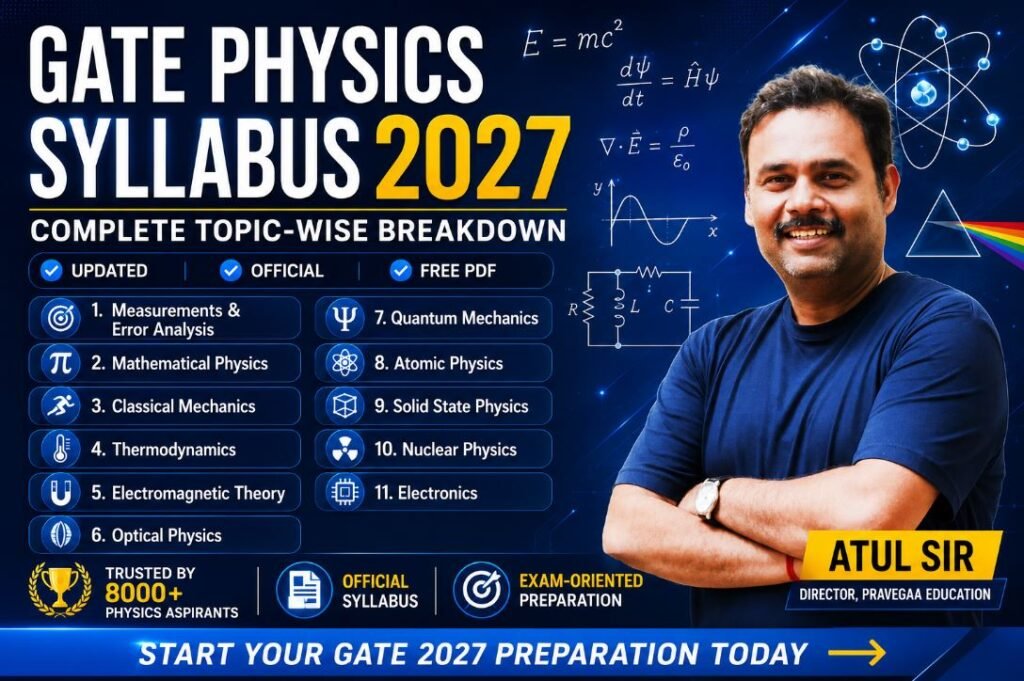
Quick Facts: GATE 2027 Physics
- Run by: IIT Madras.
- Notice out: 20 July 2026.
- Sign-up on GOAPS: 14 August to 21 September 2026 (30 September with a late fee).
- Exam days: 6, 7, 13, 14, 20 and 21 February 2027.
- Paper: 65 questions, 100 marks, 3 hours.
- Official site: gate2027.iitm.ac.in.
What Is New in the GATE Physics Syllabus 2027?
IIT Madras calls this the first big review of the GATE syllabus in five years. Besides, it has added a new paper on Robotics and Automation (RA) for engineers. But for PH, the core is still the same set of 11 sections. So your goal does not change. Instead, build deep, clear ideas first. Do not chase a “new” list of topics.
Still, always get the final brochure from the official GATE 2027 website. Check it once before you lock your plan.
GATE Physics Syllabus 2027 Exam Pattern at a Glance
| Part | Details |
|---|---|
| Total questions | 65 |
| Total marks | 100 |
| Time | 3 hours |
| General Aptitude | 10 questions, 15 marks |
| Core Physics (Sections 1 to 11) | 55 questions, 85 marks |
| Question types | MCQ, MSQ and NAT |
GATE Physics Syllabus 2027: Section-Wise Breakdown
Below, each part of the GATE Physics Syllabus 2027 has a short note and a list of its main topics. So, use it as a checklist. Then tick each topic once you can solve PYQs on it with ease.
Section 1: Measurements and Error Analysis
This part is about how we measure things in a lab and how sure we can be. Since it is short, the marks are easy to earn. Do not skip it.
- Units, dimensions and dimensional analysis.
- Then, least count and significant figures.
- Ways to measure and to work out errors.
- Also, 2-probe and 4-probe resistance checks.
- Grounding and ground loops in circuits.
- Finally, DC power supply design and lock-in amplifiers.
Section 2: Mathematical Physics
This is the toolkit for the whole paper. So, when your maths is strong, every other section feels lighter. Start here, and go slow.
- Linear vector spaces: basis, orthogonality and completeness.
- Then, matrices: similarity transforms, diagonalization, eigenvalues and eigenvectors.
- First and second order linear differential equations.
- Also, complex analysis: Cauchy-Riemann conditions, Cauchy’s theorem, singularities and the residue theorem.
- Fourier analysis.
- Finally, tensors: transforms, covariant and contravariant forms.
Section 3: Classical Mechanics
This section tests how well you can set up a problem, not just solve it. So, practise writing the Lagrangian for many kinds of systems. Then check your units at the end.
- D’Alembert’s principle and the Euler-Lagrange equation.
- Then, Hamilton’s principle and the calculus of variations.
- Symmetry and conservation laws.
- Also, central force motion and the Kepler problem.
- Small and coupled oscillations, and normal modes.
- Later, rigid bodies: the inertia tensor, Euler angles and the free symmetric top.
- Hamiltonian mechanics, canonical transforms and Poisson brackets.
- Finally, special relativity: Lorentz transforms, relativistic kinematics and mass-energy equivalence.
Section 4: Thermodynamics and Statistical Mechanics
Here, you link the laws of heat to the motion of many small parts. Still, most questions turn on one idea: the partition function. Learn it well, and the rest is quick.
- Laws of thermodynamics.
- Then, macrostates, microstates, phase space and ensembles.
- Partition function and free energy.
- Also, classical and quantum statistics.
- Degenerate Fermi gas.
- Later, black body radiation and Planck’s law.
- Bose-Einstein condensation.
- Finally, first and second order phase transitions, phase equilibria and critical phenomena.
Section 5: Electromagnetic Theory
This is a large and steady scorer. Also, most of it rests on Maxwell’s equations, so learn them well. Draw a sketch for each one.
- Electrostatics and magnetostatics.
- Then, boundary value problems, the method of images and separation of variables.
- Dielectrics, conductors and magnetic materials.
- Also, multipole expansion.
- Maxwell’s equations, scalar and vector potentials.
- Later, Coulomb and Lorentz gauges.
- EM waves in free space and in media.
- Reflection and transmission at normal and oblique incidence.
- Finally, polarization and the Poynting vector and theorem.
Section 6: Optical Physics
Optics questions are often short and direct. So, with a clear grasp of waves, you can solve them fast. Keep a list of key results.
- Wave equations, superposition and standing waves.
- Then, phase and group velocity.
- Interference: coherence, thin films and Newton’s rings.
- Also, Michelson and Fabry-Perot interferometers.
- Diffraction: Fresnel, Fraunhofer, the Rayleigh criterion and gratings.
- Later, polarization: Jones vectors and matrices, and birefringence.
- Ray-transfer matrices.
- Finally, lasers: Einstein coefficients, population inversion, and two- and three-level systems.
Section 7: Quantum Mechanics
This is the largest section by marks, so give it the most time. Besides, it feeds into atomic and nuclear physics. Work on it a bit each day.
- The uncertainty principle.
- Then, linear vectors and operators in Hilbert space.
- The time-independent Schrödinger equation.
- Also, 1D potentials: the step, the finite well and tunnelling.
- Particle in a box (1D to 3D) and delta function potentials.
- Later, harmonic oscillator and degeneracy.
- Central potentials and the hydrogen atom.
- Orbital and spin angular momentum, and adding angular momenta.
- Variational method and time-independent perturbation theory.
- Finally, basic scattering theory and the Born approximation.
Section 8: Atomic and Molecular Physics
This part builds on quantum mechanics. Also, many questions ask you to count lines or split levels in a spectrum. Learn the rules, then test them.
- Spectra of one- and many-electron atoms.
- Then, spin-orbit coupling: L-S and j-j coupling.
- Fine and hyperfine structure.
- Also, Zeeman, Paschen-Back and Stark effects.
- Selection rules for electric dipole transitions.
- Later, rotational and vibrational spectra of diatomic molecules.
- Electronic transitions and the Franck-Condon principle.
- Raman effect.
- Finally, NMR, ESR, X-ray and Mössbauer spectroscopy.
Section 9: Solid State Physics
This section is wide, but each topic is quite short. So, make a one-page note for each and revise it often. Keep it short and clear.
- Crystal structure and diffraction methods.
- Then, bonding in solids.
- Lattice waves and heat properties.
- Also, free electron theory and band theory (nearly free electron model).
- Metals, semiconductors and insulators.
- Later, carriers in intrinsic and extrinsic semiconductors.
- Metal-semiconductor junctions.
- Dielectric and magnetic properties of solids, from dia- to ferrimagnetism.
- Finally, superconductivity: Type I and II, the Meissner effect, the London equation, BCS theory and flux quantization.
Section 10: Nuclear and Particle Physics
Most questions here are fact-based or need one or two steps. So, steady revision pays off well. Read it twice a week.
- Binding energy, and electric and magnetic moments.
- Then, semi-empirical mass formula.
- Liquid drop and shell models.
- Also, nuclear force and the two-nucleon problem.
- Alpha and beta decay, and EM transitions.
- Later, Rutherford scattering, nuclear reactions and conservation laws.
- Fission and fusion.
- Particle accelerators and detectors.
- Particles: photons, baryons, mesons and leptons.
- Finally, quark model, isospin, and C, P and T symmetry.
Section 11: Electronics
This section is in GATE but not in the same form in CSIR NET. So, if you come from NET prep, plan extra time for it. Draw each circuit by hand.
- p-n diodes, BJTs and FETs.
- Then, negative and positive feedback circuits.
- Oscillators.
- Also, op-amps and their uses.
- Active filters.
- Later, wave generators: sine, square and triangle.
- Digital logic: combinational and sequential circuits.
- Flip-flops, timers, counters and registers.
- Finally, A/D and D/A conversion.
Want a clear plan for the full GATE Physics Syllabus 2027?
Our GATE and CSIR NET Physics courses cover each section with live classes, PYQ-led practice, doubt sessions and a full test series.
How to Prepare for the GATE Physics Syllabus 2027
Do not read the GATE Physics Syllabus 2027 once and jump straight to problem sets. Instead, take it step by step. Also, our Five Stage Learning Model is made for a syllabus like this. The five stages are Concept Clarity, Maths Setup, Problem Solving, Exam Strategy and a Research Mindset. Here is how to use it:
- Start with the big sections. Quantum Mechanics, Mathematical Physics and Classical Mechanics carry the most marks. Besides, they feed into atomic and nuclear physics.
- Add Electronics if you come from CSIR NET. The two exams share about 85% of the syllabus. Still, Electronics and General Aptitude are extra for GATE.
- Solve PYQs by section, not by year. This way, you see how each topic has been asked over time.
- Take full mocks once 60 to 70% is done. Then your exam skills grow with your concepts. Do not leave them for the last month.
GATE Physics Syllabus 2027 vs CSIR NET: How Much Overlaps?
Are you already preparing for CSIR NET Physical Sciences? Then here is good news. In fact, the GATE Physics Syllabus 2027 shares about 85% of its topics with CSIR NET Part C. As a result, many students prepare for both at once. So they use the same core study plan. Then they add only Electronics and General Aptitude for GATE. This also keeps more doors open, since a GATE score helps with MSc, PhD and some PSU and research jobs.
GATE Physics Syllabus 2027: Frequently Asked Questions
Has the GATE Physics Syllabus 2027 changed?
IIT Madras says this is the first big review in five years. However, the PH paper keeps the same 11-section plan shown in this guide. So, check the final brochure on gate2027.iitm.ac.in before you lock your plan.
How many sections are in the GATE Physics Syllabus 2027?
The GATE Physics Syllabus 2027 has 11 core physics sections. Besides that, every GATE paper has a General Aptitude section.
What is the GATE Physics 2027 exam pattern?
You get 65 questions for 100 marks in 3 hours. Here, General Aptitude has 10 questions for 15 marks. Meanwhile, Core Physics has 55 questions for 85 marks. However, wrong MCQ answers lose marks.
When is the GATE 2027 exam?
It is on 6, 7, 13, 14, 20 and 21 February 2027. Sign-up on GOAPS runs from 14 August to 21 September 2026, or 30 September with a late fee.
Is CSIR NET prep enough for GATE Physics?
Almost. The two share about 85% of the GATE Physics Syllabus 2027. So, add focused Electronics study and General Aptitude practice, and you will be ready.
More Resources for the GATE Physics Syllabus 2027
- Past papers in our GATE Physics PYQ papers (2018 to 2026) section.
- Practice with the free GATE Physics online test series.
- Last year’s list in the GATE Physics Syllabus 2026 guide.
- Trends in our GATE Physics exam direction and strategy analysis.
- A fast track with the GATE Physics crash course.
Prepare for GATE Physics 2027 with Pravegaa Education
8,000+ selections | AIR 1 in CSIR NET JRF | Faculty from IIT Delhi and EPFL backgrounds
Call or WhatsApp: 8920759559 · 8076563184
Source: GATE Physics Syllabus 2027 as released by IIT Madras, the organising institute. Always check the official brochure at gate2027.iitm.ac.in before you finalise your prep.