IIT JAM 2026: A Low Cutoff Is Not Good News — It Is a Warning By Atul Gaurav (Director, Pravegaa Education)
The IIT JAM Physics 2026 results are out. For Pravegaa students, this has been a moment of celebration — students who prepared seriously, built conceptual depth, and trusted the process have achieved results that reflect that preparation. We are proud of every one of them.
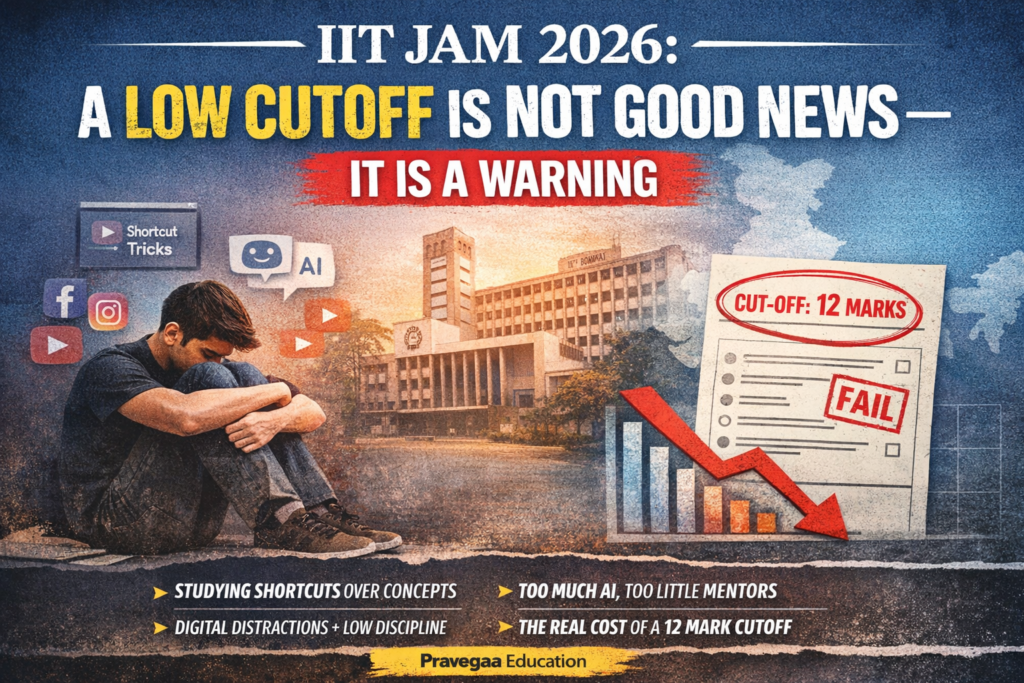
But there is another number from this result cycle that I cannot ignore, and that I believe every physics aspirant preparing for IIT JAM 2027 needs to sit with carefully: the qualifying cutoff for IIT JAM Physics 2026 dropped to just 12.04 marks out of 100.
Many students will see this as good news. A low cutoff means it is easier to qualify. More aspirants will be in the merit list. Counselling will include a wider pool of candidates.
I want to offer a different reading. A low cutoff on a moderate paper is not an opportunity. It is a warning sign about the quality of preparation happening across the ecosystem — and it should make every serious aspirant more alert, not more relaxed.
What the Numbers Actually Say
Let us be precise about what happened. The IIT JAM Physics 2026 paper was conducted on February 15, 2026 by IIT Bombay. The official qualifying cutoffs released on March 19, 2026 were:
| Category | Qualifying Cutoff (Marks out of 100) |
|---|---|
| General (GEN) | 12.04 |
| OBC-NCL / EWS | 10.83 |
| SC / ST / PwD | 6.02 |
12.04 marks out of 100. That is the qualifying benchmark for one of India’s most important postgraduate physics entrance examinations.
Now consider the paper. The IIT JAM 2026 Physics paper was assessed by multiple independent analysts as moderate in difficulty — conceptually demanding, diagram-based in significant portions, requiring strong numerical accuracy in the NAT section, but not an outlier in terms of toughness. It was not the hardest paper in the last decade. It was a standard IIT JAM Physics paper of the kind aspirants should expect every year.
A moderate paper. A 12-mark qualifying cutoff. The logical conclusion is not that the paper was too hard. The conclusion is that a large portion of the aspirant pool was not adequately prepared.
Why This Is Happening: The Preparation Quality Crisis
Over the past few years, I have observed a systematic shift in how many physics aspirants approach IIT JAM preparation. The shift is not in effort — students are putting in significant hours. The shift is in the nature of that effort. And that nature has changed in ways that feel productive but are not.
The Passive Learning Trap
A growing number of aspirants prepare primarily by watching — video lectures, solution walkthroughs, concept explainer content. This feels like studying. It involves attention, time, and what feels like comprehension. But watching someone else solve a physics problem does not build the ability to solve a physics problem independently under exam conditions. It builds familiarity, not understanding. These are not the same thing.
IIT JAM Physics does not test whether you have seen a concept demonstrated. It tests whether you can apply it when no demonstration is available — when you see a fresh problem with no hints, no solution visible, and a clock running. That ability is built through active problem solving, not passive watching.
The AI Over-Reliance Problem
AI tools have entered physics preparation — and they can be genuinely useful when used correctly. But I am seeing a pattern that concerns me: students using AI to generate answers to their doubt questions, rather than doing the cognitive work of resolving the doubt themselves.
When a student struggles with a Quantum Mechanics derivation, the productive response is to sit with that struggle — to identify where the reasoning breaks down, to revisit the prerequisite concept, to work through it with a mentor or a textbook until genuine understanding is achieved. The shortcut of asking an AI for the solution bypasses that entire process. The student gets the answer. They do not get the understanding that the struggle would have produced.
AI accelerates information retrieval. It does not replicate the cognitive work of building a physicist’s understanding. Students who rely heavily on AI to resolve doubts are not resolving doubts — they are outsourcing the thinking that should be building their capability.
Shortcuts Over Depth
IIT JAM Physics has moved steadily toward testing conceptual clarity and application rather than formula recall. The 2026 paper continued this trend — diagram-based questions, NAT sections requiring precise numerical reasoning, MSQs demanding that all correct options be identified without options to guess from.
These question types reward aspirants who understand physics deeply. They systematically penalise those who have prepared using shortcut methods — trick-based approaches, template memorisation, pattern matching without understanding. The paper is designed to find the students who actually know physics. When the cutoff is 12 marks, it suggests a large portion of the pool was not found.
Distraction and Inconsistency
Sustained preparation for IIT JAM Physics requires months of disciplined, focused daily effort. Social media, short-form content, and digital distraction actively work against this. A student who studies three intense hours one day and barely opens a book the next three days is not preparing — they are generating the feeling of preparation without the substance of it. Inconsistency in physics preparation is not inefficiency. It is preparation that does not compound.
What a 12-Mark Cutoff Means for You as an Aspirant
If you are preparing for IIT JAM Physics 2027, here is what this result tells you:
The qualifying cutoff and your target score are different things
Scoring 12 marks places you in the merit list. It does not get you into any IIT. For MSc Physics admission at top IITs — Bombay, Delhi, Kanpur, Madras, Roorkee — a competitive score is in the range of 50 to 75+ marks. Qualifying and getting admission are separated by 40 to 60 marks of preparation quality. The low cutoff creates an illusion that the bar is low. It is not. The bar for qualifying is low. The bar for getting into a good IIT is exactly what it has always been.
The competition above the cutoff is the real competition
The students who score 50, 60, 70+ marks in IIT JAM Physics are not competing with those who barely clear 12 marks. They are competing with each other — and that pool is serious, well-prepared, and studying hard. When the overall cutoff drops, the spread at the top becomes the battleground. Your preparation needs to be calibrated to that spread, not to the qualifying floor.
A low cutoff is a structural signal, not a personal invitation to relax
If your preparation is weak and you qualified with 13 marks, the low cutoff did not validate your preparation — it temporarily masked its insufficiency. That insufficiency will be fully visible in the opening and closing ranks of the counselling process, when 12 marks places you far outside the admission range for any meaningful IIT programme.
What Pravegaa Students Did Differently
The Pravegaa students who performed well in IIT JAM 2026 did not do so because the paper was easy or the cutoff was low. They performed well because of how they prepared — and that how is worth examining.
- They solved problems, not watched solutions. Every topic was followed by active problem solving — books closed, no hints visible, genuine attempt before any reference.
- They resolved doubts at the point of confusion. No doubt was carried forward unresolved. Faculty access for real-time doubt clearing was used as a structural part of preparation, not as an emergency measure.
- They used PYQs as diagnostic tools, not revision tools. Previous year questions were integrated from the beginning — used to understand what the exam tests and how, not stockpiled for the final month.
- They took mock tests seriously and analysed every error. Taking the IIT JAM Test Series was not a performance — it was a diagnostic. Every wrong answer was a signal about a specific gap to fix before the next test.
- They prepared consistently, not in bursts. Daily structured preparation over 6 to 12 months, not intense weekend sessions interspersed with weeks of inactivity.
These habits are not special or rare. They are the basic requirements of serious physics preparation. But they require structure, accountability, and a preparation environment that enforces them — which is what Pravegaa’s results reflect year after year.
The Message for IIT JAM 2027 Aspirants
If you are targeting IIT JAM 2027, what happened in 2026 is directly relevant to your preparation strategy. Here is what I want you to take from it:
1. Do not mistake a low cutoff for a low bar
The bar for IIT JAM Physics admission at top institutes has not changed. What has changed is the average quality of the aspirant pool. That creates an opportunity for the serious, well-prepared student — and a trap for anyone who uses the low cutoff as a reason to prepare less rigorously.
2. Build depth, not coverage
The IIT JAM 2026 paper tested conceptual clarity, numerical precision, and the ability to apply physics to unfamiliar problems. Surface-level syllabus coverage does not produce this ability. Deep, slow, concept-first preparation — topic by topic, with active problem solving after every unit — does. Check the complete IIT JAM Physics syllabus and plan your preparation unit by unit, not as a broad sweep.
3. Use previous year questions from the start
Download IIT JAM Physics previous year question papers and integrate them into your preparation from day one — not as final revision, but as your continuous calibration against the actual exam standard. They tell you exactly what depth is required in each topic.
4. Get a structured preparation environment
Self-study without accountability, without doubt resolution, and without external benchmarking produces exactly the kind of aspirant the 2026 cutoff reflects — someone who studied, but not effectively enough. A structured programme that enforces daily preparation, resolves doubts at the point of occurrence, and benchmarks you nationally through regular testing is not a luxury — it is what serious preparation requires.
5. Start immediately — not when you feel ready
IIT JAM 2027 will be in February 2027. That window is closing faster than it appears. The aspirants who will score 60+ marks in that paper are already preparing with structure and consistency. The aspirants who will score 12 marks are waiting to feel ready before they start. Do not be in the second group.
“The IIT JAM 2026 result is not just an outcome. It is a reflection of a changing preparation ecosystem. If a moderate paper produces a 12-mark cutoff, the concern is not the exam — it is the system. And for every aspirant willing to take that signal seriously, it is also an opportunity.”— Atul Gaurav, Founder & Director, Pravegaa Education
Frequently Asked Questions
Was the IIT JAM 2026 Physics paper unusually difficult?
No. Independent analyses and student feedback categorised the 2026 Physics paper as moderate — conceptually demanding and diagram-heavy, but not among the hardest papers in recent years. The low cutoff reflects the performance of the aspirant pool, not an unusually difficult paper.
Does a 12-mark cutoff mean qualifying IIT JAM is now easier?
Qualifying — yes. Getting admitted to a meaningful IIT programme — no. The opening and closing ranks at top IITs are set by the scores of the highest-performing candidates, which remain competitive. A 12-mark cutoff only affects the qualifying bar; it does not lower the admission bar at IIT Bombay, IIT Delhi, or IIT Kanpur.
Can AI tools genuinely help with IIT JAM Physics preparation?
AI tools can help with quick information retrieval, concept overviews, and generating practice problems. What they cannot replace is the cognitive work of genuinely resolving a doubt — the struggle that builds understanding. Used as a supplement alongside structured preparation and faculty mentorship, AI can be useful. Used as a substitute for active thinking, it weakens preparation.
How many marks should I target in IIT JAM Physics 2027 for top IITs?
A score of 60+ marks gives you a realistic shot at top IITs like Bombay, Delhi, and Kanpur. A score of 75+ marks puts you in strong contention for AIR in the top 50–100. Target your preparation at 65–70 marks minimum — not at the qualifying cutoff.
What is the most important change a struggling aspirant can make right now?
Stop passive consumption and start active problem solving. For every hour currently spent watching lectures or reading solutions, shift 40 minutes to solving problems without references — unseen questions, genuine attempts, then analysis of errors. That shift alone will produce more improvement than any increase in study hours.
Prepare With Structure, Depth, and Accountability
At Pravegaa, preparation is built to avoid exactly the failure modes the 2026 result exposed. Concept-first teaching. Active problem solving. Real-time doubt resolution. PYQ-integrated classes. National-level test series benchmarking. Consistent daily structure over months — not bursts.
If you are serious about IIT JAM 2027, use these resources to begin your preparation with the right foundation:
- IIT JAM Physics Online Live Course — concept-first live classes, PYQ-driven sessions, weekly tests, real-time doubt clearing
- IIT JAM Physics Online Coaching — structured online preparation with mentorship and interactive sessions
- Evening & Weekend Programme (CPOP) — IIT JAM preparation alongside college without a drop year
- IIT JAM Physics Test Series — All India Rank, topic-wise and full mock tests, detailed performance analytics
- IIT JAM 60-Day Strategy Guide — a complete preparation blueprint by Atul Gaurav
- IIT JAM Physics PYQ Papers (Free) — official papers from 2016 to 2026, free PDF download
- Free Physics Study Material — topic-wise notes, formula sheets, and concept guides
- All Pravegaa Courses — full range of IIT JAM and CSIR NET programmes