How to Prepare for IIT JAM Physics Exam 2027 & 2028: A Research-Oriented Long-Horizon Strategy
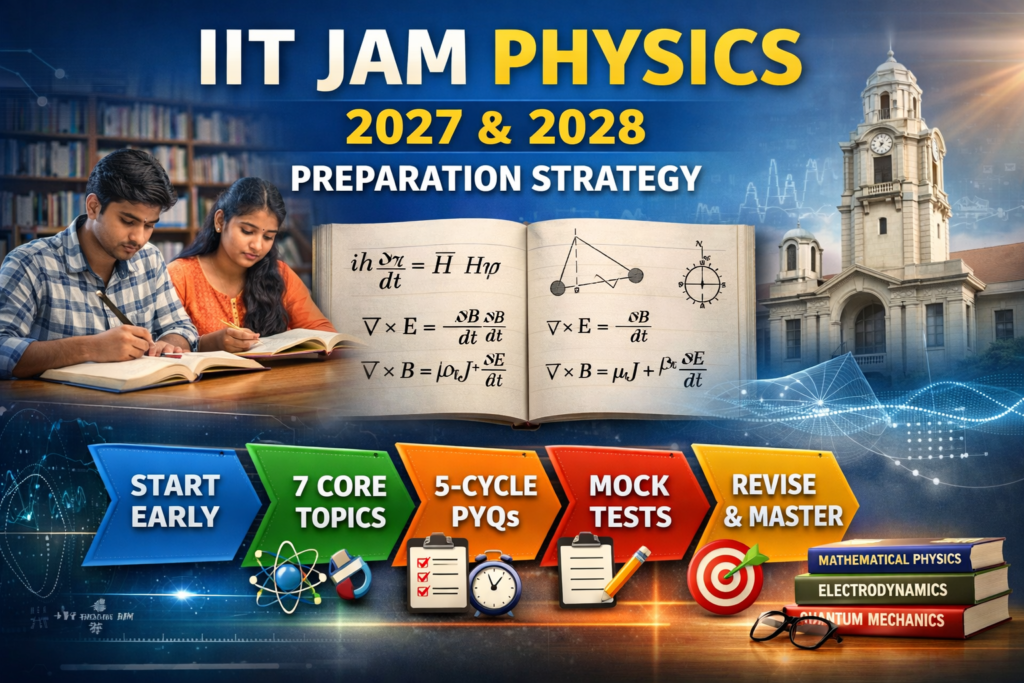
If you are serious about learning how to prepare for the IIT JAM Physics exam for 2027 or 2028, the most important thing to understand first is this: IIT JAM Physics cannot be rushed, crammed, or shortcut. It must be built — patiently, coherently, and honestly — over a preparation period that is long enough to develop genuine physical understanding rather than exam-ready pattern recognition.
This guide gives you the research-oriented, long-horizon preparation framework that Pravegaa Education uses to build IIT JAM Physics rankers — not aspirants who qualified, but aspirants who earned competitive ranks at top IITs through preparation quality that holds up under the actual exam’s conceptual demands.
What IIT JAM Physics Actually Tests — and Why It Matters for Preparation
Before planning how to prepare for IIT JAM Physics, you need to be precise about what the exam actually measures. IIT JAM Physics is not a knowledge recall test. It does not ask you to reproduce facts or apply memorised formulas to familiar problems. It asks you to apply physics principles to problems you have not seen before — under time pressure, across three different question types, with marking rules that penalise guessing and reward precision.
Specifically, IIT JAM Physics rewards:
- Conceptual clarity — the ability to understand the physics behind a problem, not just the mathematical steps to solve a familiar variant of it
- Mathematical fluency — the ability to execute multi-step calculations correctly under time pressure, with unit awareness and dimensional consistency
- Physical reasoning — the ability to translate a physical situation into mathematical language and interpret results physically
- Problem-solving adaptability — the ability to handle unfamiliar question structures using a solid conceptual foundation, not memorised templates
This tells you precisely what preparation must produce. Not recognition — understanding. Not speed — accuracy. Not coverage — depth.
How to Prepare for IIT JAM Physics Exam: The Long-Horizon Framework
The most reliable IIT JAM Physics preparation follows a four-phase structure spread across the full preparation window — whether that is 18 months (for 2027 aspirants starting now) or 30 months (for 2028 aspirants in early BSc). Each phase has a distinct purpose, and rushing any phase to get to the next one is one of the most common preparation errors.
Phase 1 — Foundation Building (Months 1–4)
Goal: Build the mathematical and mechanical foundation that every subsequent topic depends on.
Topics: Mathematical Physics (linear algebra, vector calculus, complex analysis, differential equations, Fourier series) and Classical Mechanics (Newton’s laws, central force motion, Lagrangian formulation, oscillations, rotational dynamics).
How to study in this phase:
- Work through standard textbooks (Mary L. Boas for Mathematical Physics, Kleppner and Kolenkow for Mechanics) — not passively reading, but actively solving every example before checking the solution
- Build the habit of deriving results from first principles, not memorising them — re-derive key results from memory at the end of each chapter
- Begin PYQ practice within each topic as soon as you complete it — do not wait until the full syllabus is covered
- At the end of each topic, test yourself on 8 to 10 unseen problems before moving to the next topic
Why this phase matters most: Mathematical Physics is the language every other topic is written in. Mechanics builds the physical intuition that makes advanced topics tractable. Weak foundations in these two areas create compounding problems in every subsequent phase.
Phase 2 — Core Physics Depth (Months 4–9)
Goal: Build deep, exam-level understanding of the high-mark topics that require Phase 1 foundations.
Topics: Electrodynamics (Griffiths — electrostatics, magnetostatics, Maxwell’s equations, EM waves), Quantum Mechanics (Griffiths — Schrödinger equation, standard systems, operators, spin, perturbation theory), and Thermodynamics and Statistical Mechanics (Reif — laws of thermodynamics, entropy, partition functions).
How to study in this phase:
- Electrodynamics and Quantum Mechanics must be taught using the standard international references (Griffiths for both) — not shortcut notes that summarise without developing the physics
- Solve Griffiths problems actively — they are specifically calibrated to build the kind of understanding IIT JAM tests
- For Thermodynamics, focus on developing physical intuition alongside the mathematics — IIT JAM Thermodynamics questions often probe the meaning of quantities (entropy, free energy) not just their formulas
- Continue weekly PYQ practice — by now you should be doing 2 to 3 full topic-wise PYQ sets per week across the topics covered so far
Phase 3 — High-Yield Completion (Months 9–13)
Goal: Complete the remaining syllabus with particular emphasis on the highest-weightage topic cluster — Solid State Physics and Electronics — and consolidate all previous topics through integrated problem-solving.
Topics: Solid State Physics and Electronics (highest single-cluster weightage at 19 to 20%), Oscillations, Waves and Optics, Modern Physics.
How to study in this phase:
- Treat Solid State and Electronics as a priority zone — allocate 4 to 6 weeks of focused preparation. Crystal structure, band theory, semiconductor devices, digital logic, and op-amps all appear consistently in the IIT JAM paper
- Modern Physics requires calculation depth, not just conceptual familiarity — the Bohr model, Compton scattering, radioactive decay law, and Lorentz transformations all appear regularly as NAT questions
- Begin subject-level integrated tests that combine multiple topics — this builds the cognitive switching ability that the actual paper requires
- Start the first full-length mock exam by the end of this phase
Phase 4 — Mock Practice, Error Correction, and Final Preparation (Months 13–18)
Goal: Convert preparation into exam performance through structured mock practice, systematic error analysis, and exam-day execution skill-building.
Activities in this phase:
- One full-length IIT JAM Physics mock exam per week under real exam conditions — 3 hours, no interruptions, exact section-wise strategy
- After each mock: 2 to 3 hours of systematic error analysis — classify every wrong answer by type (concept gap, calculation error, question misread, negative marking error), identify the specific topic and sub-topic, fix it before the next mock
- Targeted revision of topics where mock performance reveals persistent gaps — this is more valuable than general revision of topics where you are already strong
- Final week strategy: no new learning, light formula review, one Section C (NAT) practice session, and psychological preparation for exam-day execution
For the final phase blueprint in detail, see Pravegaa’s IIT JAM 60-day strategy guide and the final 7-day exam execution plan.
Semester-Wise Roadmap for IIT JAM 2027 and 2028 Aspirants
| Aspirant | Current Stage | When to Start | Recommended Approach |
|---|---|---|---|
| IIT JAM 2027 aspirant | BSc 2nd year (now) | Immediately | Full 18-month programme — all 4 phases with adequate time for each |
| IIT JAM 2027 aspirant | BSc 3rd year (now) | Immediately | Compressed 9 to 12 month programme — prioritise Tier 1 topics, integrate PYQs from week 1 |
| IIT JAM 2028 aspirant | BSc 1st year | After settling into college (Month 2–3) | Begin Mathematical Physics alongside coursework; build foundation slowly but consistently |
| IIT JAM 2028 aspirant | BSc 2nd year | Now — full time | Full 18-month programme gives optimal time for depth and revision cycles |
| Working/MSc student targeting IIT JAM | Any stage | Now | Evening/weekend programme (CPOP); map preparation to available hours; structured guidance essential |
The Research Mindset: Why It Changes How You Prepare
At Pravegaa, we teach IIT JAM Physics as a research entrance — not as a competitive exam in the traditional Indian coaching sense. This distinction matters practically, not just philosophically.
A researcher thinks about physics problems by asking: What is the physical situation? What principles govern it? What does my answer physically mean? Are there limiting cases I can check? An exam-oriented student asks: Which formula do I apply? Have I seen this type before? What is the fastest path to the answer?
IIT JAM Physics is specifically designed to distinguish between these two mindsets. The examiner constructs questions to defeat the second approach — by presenting familiar physical situations in unfamiliar framing, by combining two principles that are separately understood but rarely applied together, by testing the physical meaning of a result rather than just the result itself.
Developing the research mindset in your preparation means:
- Always asking why a formula is true, not just what it says
- Always checking limiting cases and physical intuition against mathematical results
- Always looking for the connection between the current topic and topics you have already studied
- Always treating PYQs as the examiner’s communication — studying what they reveal about how topics are tested, not just whether you got the right answer
PYQ Strategy: The 5-Cycle Approach
Previous year questions are the most important preparation resource for IIT JAM Physics — more important than any textbook, any lecture series, or any study material. They are the examiner’s direct communication about what depth is required, which aspects of each topic matter, and how physics understanding is tested under exam conditions.
The most effective way to use PYQs is through a 5-cycle approach across your preparation window:
- Topic-wise PYQ (ongoing from Month 1): After completing each topic, solve all PYQ questions from that topic across all available years (2016 to 2026). Do this topic by topic, throughout the preparation — not as a final revision activity.
- Error analysis PYQ review (after each topic-wise set): For every PYQ question you got wrong or were unsure about, identify the specific concept or calculation failure and address it before moving to the next topic.
- Integrated PYQ practice (Months 8–12): Solve complete previous year papers in one sitting — not under strict exam conditions yet, but to build the habit of working across all topics in sequence.
- Timed full-paper PYQ simulation (Months 13–16): Solve the last 5 years of IIT JAM Physics papers under strict exam conditions — exact time, no references, full section-wise strategy. Treat each paper as a mock exam.
- Final week PYQ calibration (Exam week): Solve only Section C (NAT) questions from the last 2 to 3 years — to keep calculation precision sharp without the fatigue of a full 3-hour simulation the day before the exam.
Download all IIT JAM Physics PYQ papers from 2016 to 2026 free at pravegaa.com/iit-jam-physics-question-paper.
How to Synchronise IIT JAM Preparation with BSc Coursework
One of the most common concerns among 2027 and 2028 aspirants is how to manage IIT JAM preparation alongside their BSc Physics degree. The short answer is that the two should not be managed separately — they should be synchronised.
The IIT JAM Physics syllabus is essentially the BSc Physics Honours curriculum — the same core topics, at a similar depth level. When your BSc semester is covering Electrodynamics, your IIT JAM preparation should be deepening Electrodynamics. When your coursework reaches Quantum Mechanics, your IIT JAM preparation intensifies Quantum Mechanics. This synchronisation turns two competing demands into one mutually reinforcing effort.
Practical synchronisation principles:
- Use IIT JAM-level textbooks (Griffiths for EM and QM, Boas for Mathematical Physics) as your primary study references, not your university course notes alone — the IIT JAM depth will strengthen your semester performance, not compete with it
- Solve IIT JAM PYQs on each topic as your university semester covers that topic — this immediately shows you the exam standard for the material you are currently studying
- Reduce IIT JAM preparation intensity during university exam weeks and compensate in the subsequent weeks — do not try to maintain identical daily hours throughout the academic year
- Use the summer breaks between academic years for intensive preparation of topics not yet covered in your coursework, particularly Solid State Physics and Electronics if your university covers them late
For students at Delhi University and NCR colleges, Pravegaa’s College Parallel Hybrid Program (DU–NCR) is designed specifically to achieve this synchronisation — with offline weekend sessions and online weekday evenings built around the DU academic calendar. For aspirants across India who cannot attend in person, the CPOP evening and weekend online programme provides the same structure fully online.
The Role of Mentorship in IIT JAM Physics Preparation
Self-study has a specific and well-documented failure mode in IIT JAM Physics preparation: undetected conceptual gaps that compound silently over months until they surface as repeated mock exam errors in multiple topic areas simultaneously. By this point, the gaps are difficult to isolate and address because they have propagated across topics.
A mentor prevents this failure mode — not by teaching you more content, but by identifying conceptual errors before they compound, recalibrating your preparation strategy when it is going off-track, and providing the kind of honest performance feedback that tells you exactly where you stand and what needs to change.
The three things a good mentor provides that self-study cannot:
- Error diagnosis at the root: When you solve a Quantum Mechanics problem incorrectly, a mentor can identify whether the error is in your QM understanding, your Mathematical Physics foundation, your calculation habits, or your question interpretation — and address each differently
- Preparation recalibration: At the 6-month mark, 9-month mark, and again at 12 months, your preparation strategy should be reviewed and adjusted based on actual mock performance data — not continued on autopilot
- Perspective during difficulty: When a topic refuses to click for weeks, the natural response without mentorship is to either persist ineffectively or skip the topic. A mentor identifies the specific bottleneck and resolves it efficiently
Explore Pravegaa’s IIT JAM Physics Online Live Course for structured preparation with integrated mentorship, or register for a free demo class to experience Pravegaa’s teaching approach before enrolling.
Topic Priority Order for IIT JAM Physics Preparation
| Priority | Topic | Primary Textbook | Exam Weightage | Why This Priority |
|---|---|---|---|---|
| 1 | Mathematical Physics | Mary L. Boas | 15–16% | Foundation for all other topics; weakness here propagates everywhere |
| 2 | Solid State Physics & Electronics | S.O. Pillai + Thomas Floyd | 19–20% | Highest single weightage; consistently underweighted in self-preparation |
| 3 | Electrodynamics | Griffiths (Electrodynamics) | 13–15% | High marks, high conceptual demand, major rank differentiator |
| 4 | Classical Mechanics | Kleppner & Kolenkow | 10–12% | Builds physical intuition; feeds into QM and EM through common methods |
| 5 | Quantum Mechanics | Griffiths (QM) + Zettili | 8–10% | Requires Math Physics and Mechanics foundations; MSQ-heavy |
| 6 | Thermodynamics & Stat Mech | F. Reif | 10–12% | NAT-heavy section; calculation depth required for Section C marks |
| 7 | Oscillations, Waves & Optics | N.K. Bajaj + Ajoy Ghatak | 12–14% | Scoring section; strong Optics performance often determines rank tier |
| 8 | Modern Physics | H.C. Verma / Arthur Beiser | 8–10% | Growing presence (elevated in 2026); calculation-intensive NAT questions |
For a complete data-driven weightage analysis of every topic, see Pravegaa’s IIT JAM Physics syllabus analysis. For the complete unit-wise syllabus with preparation guidance, visit pravegaa.com/syllabus/iit-jam.
Frequently Asked Questions — How to Prepare for IIT JAM Physics
How early should I start preparing for IIT JAM Physics?
For IIT JAM 2027, start immediately — you have approximately 18 months, which is the ideal preparation window for a competitive rank. For IIT JAM 2028, the best time to start is the beginning of your BSc 1st or 2nd year. Earlier starts allow genuinely deep preparation without time pressure; later starts require more intense daily commitment and more disciplined topic prioritisation. There is no point at which starting is too early — every month of preparation adds depth that compounds.
How many hours per day should I study for IIT JAM Physics?
For aspirants preparing alongside college: 3 to 4 focused hours per day on weekdays plus 6 to 8 hours on weekends is a sustainable and effective preparation commitment. For aspirants in a full-time preparation mode: 8 to 10 focused hours per day, with strict attention to study quality rather than raw hour count. The key word is focused — hours spent passively reading or watching without active problem solving produce significantly less improvement per hour than hours spent working through problems independently.
Should I join coaching or self-study for IIT JAM Physics?
Both approaches can produce results — but they produce different results. Self-study with strong discipline, good textbooks, and systematic PYQ practice can achieve solid qualification. Structured coaching with concept-first teaching, mentorship, and regular benchmarked testing consistently produces competitive ranks. The most common failure mode of self-study is silent conceptual gap accumulation — problems that are detectable only by a mentor or through systematic mock analysis. If top-IIT admission is the target, structured preparation with accountability significantly improves the probability.
Is one year enough to prepare for IIT JAM Physics?
Yes — one year of structured, disciplined preparation is enough to achieve a competitive rank in IIT JAM Physics for most aspirants with a solid BSc Physics foundation. The 12 months must be used efficiently: Mathematical Physics and Classical Mechanics in the first 3 months, Electrodynamics, QM, and Thermodynamics in months 3 to 7, Solid State and the remaining topics in months 7 to 10, and intensive mock practice with error analysis in the final 2 months. Aspirants starting with weaker foundations may need 15 to 18 months for the same outcome.
What is the biggest mistake aspirants make in IIT JAM Physics preparation?
Treating the syllabus as a reading list rather than a problem-solving curriculum. IIT JAM Physics is not a test of whether you have encountered each topic — it is a test of whether you can solve problems using each topic independently. Aspirants who spend 80% of their preparation time reading and watching lectures, and 20% actually solving unseen problems, consistently underperform relative to their preparation investment. The ratio should be roughly reversed: 60 to 70% active problem solving, 30 to 40% concept learning and review.
How do I know if my IIT JAM Physics preparation is on track?
Three diagnostic tools: (1) After completing each topic, attempt 10 unseen PYQ problems from that topic without references — if you cannot solve at least 6 to 7 correctly, the topic needs more work. (2) Take a full-length IIT JAM Physics mock exam every 6 to 8 weeks and track your score trend — consistent improvement signals effective preparation; a plateau signals a specific problem that needs diagnosis. (3) Use Pravegaa’s IIT JAM Physics Test Series for All India Rank benchmarking — your rank among national enrollees gives you objective preparation context that self-assessment cannot provide.
Start Your IIT JAM Physics Preparation with Pravegaa
Pravegaa Education has built IIT JAM Physics rankers for 15+ years — including multiple AIR 1 results and consistent top-100 performances — through the same research-oriented, long-horizon preparation philosophy described in this guide. The programmes listed below are designed to give every serious aspirant access to that preparation quality, regardless of location or schedule.
- IIT JAM Physics Online Live Course — concept-first live preparation, PYQ-driven sessions, weekly tests, real-time doubt clearing, recorded backup
- CPOP — Evening & Weekend Online Programme — structured preparation alongside college, no drop year required
- IIT JAM Physics Test Series — All India Rank, full-length mocks calibrated to actual paper difficulty, detailed performance analytics
- IIT JAM 60-Day Strategy Guide — complete final-phase preparation blueprint for aspirants 2 months from the exam
- IIT JAM Physics PYQ Papers (Free) — official question papers 2016 to 2026, free PDF download, no login required
- Free Physics Study Material — topic-wise notes, formula sheets, and concept PDFs for the complete IIT JAM Physics syllabus
- IIT JAM Physics Syllabus — complete unit-wise syllabus with high-yield topic guidance and preparation hints
- Understanding the IIT JAM Physics Syllabus Through Data — topic-wise weightage, PYQ frequency, and data-driven preparation priorities