An Open Letter to the Hon’ble Prime Minister of India
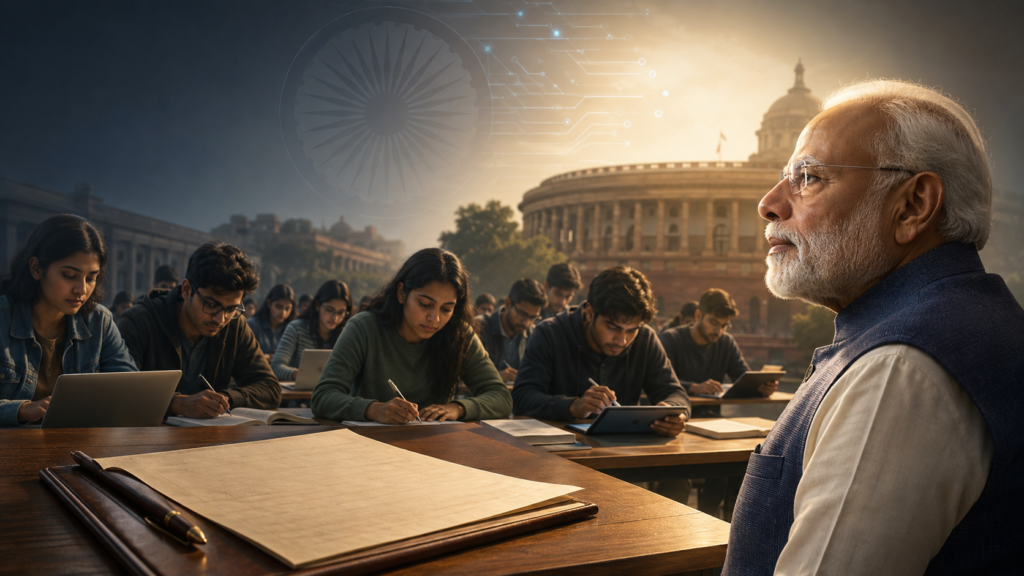
Beyond Digital Access: Five Imperatives for the Future of Indian Education
The future of Indian education will not be decided by how much content we put online. It will be decided by whether our students can actually learn from it. In this open letter to the Hon’ble Prime Minister, Atul Gaurav — physics educator and Co-Founder of Pravegaa Education — sets out five imperatives that must accompany India’s push for free digital learning: learning capacity, academic discipline, strong fundamentals, teacher excellence, and the responsible use of AI in education.
Respected Prime Minister Sir,
Your address to the nation on India’s Independence Day presented a powerful vision of self-reliance, technological empowerment, job creation, and educational opportunities for economically weaker students.
Your initiative to provide free online preparation for competitive examinations is especially commendable. It reflects a deeply inclusive objective: ensuring that financial limitations do not prevent deserving students from accessing quality education in India.
However, as a teacher who has spent nearly two decades teaching higher physics and competitive examination aspirants, I feel it is important to share a reality that is becoming increasingly visible inside our classrooms.
The challenge before Indian education is no longer only about access to content.
It is increasingly about the learning capacity, academic discipline, strong fundamentals, teacher quality, and educational environment required to convert digital access into real learning.
I respectfully submit five observations that, in my view, deserve urgent national attention as we shape the future of Indian education.
1. The Real Crisis in Indian Education Is Not Content Scarcity, but Learning Capacity
India today does not suffer from a shortage of online educational content.
Outstanding lectures and learning resources are already available from institutions such as MIT, Oxford, Yale, NPTEL, universities, coaching organisations, and individual educators. At Pravegaa Education too, we have made sustained efforts to provide high-quality physics education and competitive exam preparation.
The problem, therefore, is not simply the availability of knowledge.
In other words, supply is no longer the binding constraint.
The deeper concern is whether students are sufficiently prepared to understand, absorb, connect, and apply that knowledge.
Creating more digital education content without strengthening the learner may eventually produce diminishing returns.
The central question should therefore shift from:
“How much educational content can we provide?”
to:
“How effectively can our students learn from it?”
2. Academic Discipline and Deep Focus Are Declining
A serious challenge visible across both offline education and online education is the decline in student attendance, consistency, academic discipline, and sustained concentration.
Indeed, even in fee-paying institutions, many students do not attend classes regularly.
In online education, the problem is often more pronounced. Students begin enthusiastically, but over time lectures remain unwatched, assignments remain incomplete, and continuity breaks down.
This generation has access to more information than any generation before it, yet many students struggle with patience, consistency, and prolonged intellectual effort.
Consequently, innovation cannot emerge from passive consumption.
If India wants to create scientists, researchers, engineers, innovators, and original thinkers, we must rebuild a culture of academic discipline, responsibility, curiosity, and deep focus. This is precisely why our CSIR NET Physics coaching programmes are built around continuous assessment and accountability rather than lecture volume alone.
3. Weak Fundamentals Are Undermining Higher Education in India
One of the most serious concerns I observe while teaching advanced physics is the weakness of fundamental concepts.
When students encounter higher-level mathematics, analytical reasoning, problem-solving, or deeper conceptual discussions, many struggle—not because they lack intelligence, but because their foundations are fragile.
Weak fundamentals in mathematics, science, logic, and conceptual reasoning create frustration and eventually damage student confidence.
This problem often originates much earlier in the school education system and undergraduate education system, and it is documented year after year in national learning surveys such as those published by the ASER Centre.
If education becomes overly focused on exam patterns, memorisation, short-term scoring, and rote learning, students may qualify for the next stage without developing genuine understanding.
Higher education cannot become world-class unless school education builds strong academic foundations.
Our classrooms must increasingly encourage:
- conceptual understanding
- problem-solving skills
- critical thinking
- analytical reasoning
- scientific curiosity
- independent learning
- application-based education
Students preparing for IIT JAM Physics and GATE Physics feel this gap most sharply, because both examinations reward conceptual depth far more than memorised formulae.
4. Teacher Excellence Must Come Before Content Expansion
Technology can distribute information at enormous scale, but it cannot replace the role of an excellent teacher.
Certainly, a digital platform can deliver a lecture.
A great teacher can identify confusion, challenge weak assumptions, create curiosity, build confidence, and gradually train a student to think independently.
For this reason, teacher training and teacher development in India should become one of our highest educational priorities — an emphasis the National Education Policy 2020 itself recognises.
We need continuous and meaningful teacher training programmes—not merely occasional workshops.
Teachers should receive deeper training in:
- subject knowledge
- modern pedagogy
- student assessment
- educational technology
- critical thinking methods
- concept-based teaching
- problem-solving approaches
If India wants world-class students, it must first create and empower world-class teachers.
No single investment shapes the future of Indian education more directly than the quality of the person standing in front of the class.
5. AI in Education Must Remain a Co-Pilot, Not a Substitute for Thought
Artificial Intelligence in education, digital learning platforms, and modern EdTech will undoubtedly play an important role in India’s future.
Moreover, they can personalise learning, explain difficult concepts, improve educational access, and support both students and teachers.
But technology should assist intellectual development, not replace it.
AI should be a co-pilot for learning, never a substitute for human thinking.
A student must still learn to:
read carefully, calculate independently, derive results, analyse arguments, perform experiments, solve difficult problems, and think from first principles.
The strongest education systems in technologically advanced nations still rely heavily on strong teachers, demanding coursework, laboratories, discussions, assignments, and rigorous independent thinking.
Technology is most powerful when it works as a co-pilot to human intelligence, not as a surrogate for it. That distinction will define the future of Indian education far more than the pace of adoption.
If India wishes to move from being a consumer of global technology to becoming a creator of original science and technology, our students must retain the ability to think independently.
A Humble Appeal for the Future of Indian Education
Sir, providing free educational access to economically weaker students is an important and admirable step.
But access alone cannot guarantee educational transformation.
Our national education strategy must simultaneously focus on:
- Depth of learning over volume of content
- Academic discipline and sustained effort over passive consumption
- Strong fundamentals over superficial examination preparation
- Teacher excellence and teacher training over endless platform expansion
- Critical thinking and independent learning over dependence on technological shortcuts
India’s demographic dividend can become one of the greatest forces for economic growth, scientific innovation, and technological leadership in the world—but only if we transform access into genuine intellectual capability.
India’s future will not be determined by how many hours of educational video our students watch.
It will be determined by how deeply they understand, how independently they think, how seriously they work, and what original knowledge they are ultimately capable of creating for the world.
With profound respect and unwavering commitment to India’s youth,
Atul Gaurav
Teacher & Co-Founder
Pravegaa Education Pvt. Ltd.
New Delhi
Frequently Asked Questions on the Future of Indian Education
What is the biggest challenge facing the future of Indian education?
The biggest challenge is no longer access to content. High-quality lectures and study material are freely available from NPTEL, global universities and Indian educators. The real constraint is learning capacity — whether students have the fundamentals, discipline and attention span required to convert that access into genuine understanding.
Is free online coaching enough to help economically weaker students?
In short, free online coaching removes a financial barrier, which matters enormously. But it does not by itself build academic discipline, strong school-level fundamentals, or the mentorship a student needs when a concept breaks down. Access has to be paired with teacher support, structured assessment and accountability — and the future of Indian education depends on getting that combination right.
Why are weak fundamentals a problem for higher education in India?
Above all, advanced physics, mathematics and engineering assume a secure base in algebra, calculus, logic and conceptual reasoning. When that base is fragile, students who are perfectly intelligent still struggle at the postgraduate and research-entry level, and their confidence erodes. The gap usually originates in school and undergraduate education, not in the higher-education classroom itself.
Should AI replace teachers in Indian classrooms?
No. In fact, AI can personalise practice, explain concepts on demand and extend a teacher’s reach. What it cannot do is diagnose a student’s specific confusion, challenge a weak assumption, or build the intellectual stamina that original research demands. AI works best as a co-pilot to a strong teacher, never as a substitute for one.
How does Pravegaa Education approach these problems?
Pravegaa Education is a physics-only institute built around conceptual clarity, previous-year-question-driven practice and small batches with direct faculty engagement. Our CSIR NET Physics, IIT JAM Physics and GATE Physics programmes are designed to build a physicist’s mindset rather than exam shortcuts. You can contact our team to discuss the right programme for your preparation.