
The IIT JAM Physics 2027 syllabus is large. So most students lose time just deciding where to begin. In this guide, you get the full unit-wise syllabus and the weightage of each unit in past papers. Also, you get a study order that builds concepts step by step, instead of covering topics in isolation.
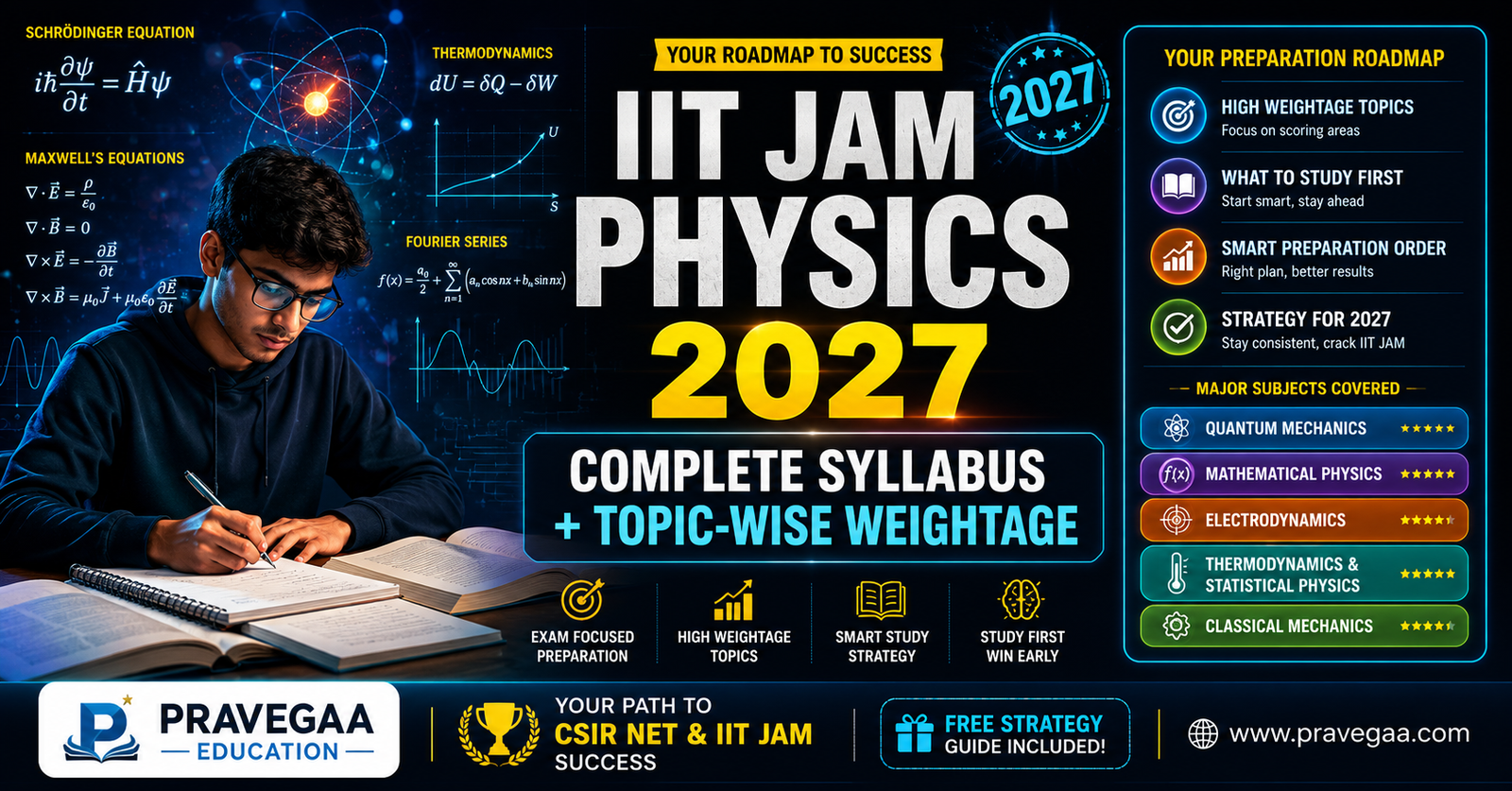
Quick summary: The IIT JAM Physics 2027 syllabus covers 8 units, tested through 60 questions (100 marks) in a 3-hour computer-based exam. Together, Mathematical Physics, Electricity and Magnetism, and Quantum Mechanics carry nearly 45% of the marks. So this guide gives you the full syllabus, PYQ-based weightage and the best order to study it.
Not sure how to plan a syllabus this large?
Join a free demo class and get a study plan mapped to this syllabus, guided by faculty who teach these units.
Table of Contents
- IIT JAM Physics 2027 exam pattern
- The full syllabus: all 8 units
- Topic-wise weightage from PYQs
- What to study first
- Recommended books
- Common mistakes that drop your rank
- How Pravegaa plans your prep
- FAQs
IIT JAM Physics 2027 Exam Pattern at a Glance
Before you start the syllabus, first know the exam format. For JAM 2027, IIT Kharagpur runs the exam. So check every notice on the official JAM 2027 website.
| Item | Details |
|---|---|
| Mode | Computer-based test (CBT) |
| Time | 3 hours |
| Questions and marks | 60 questions, 100 marks |
| Section A | 30 MCQs, 1 or 2 marks each |
| Section B | 10 MSQs, 2 marks each, no negative marking |
| Section C | 20 NAT questions, no negative marking |
| Negative marking | Section A only: 1/3 (1-mark) and 2/3 (2-mark) |
Complete IIT JAM Physics 2027 Syllabus: All 8 Units
Here is the unit-wise breakdown. For each unit, we also list the best books and why it matters.
How to Read This Syllabus
Do not try to learn it all at once. Instead, take one unit at a time. First, read the list. Then mark the topics you know well. Next, mark the ones you do not know. After that, start with the weak ones in the top units. Keep a small notebook for each unit. Write the key results there. Read it once a week. Also, solve a few PYQs on each topic as soon as you finish it. That is how you see what the exam wants. Do this for every unit, and the big list will soon feel small.
Unit 1: Mathematical Physics
- Calculus in one and more variables, partial derivatives, the Jacobian, and Taylor and Fourier series.
- Also, vector algebra and vector calculus, plus the divergence, Green’s and Stokes’ theorems.
- First-order and linear second-order differential equations.
- Finally, matrices, determinants, complex numbers and error analysis.
Books: Arfken and Weber; H.K. Dass.
Why it matters: this unit is the toolkit for the whole paper. So if you master it first, every other unit gets easier.
Unit 2: Mechanics and General Properties of Matter
- Newton’s laws, and motion in Cartesian, polar and cylindrical coordinates.
- Also, central forces, Kepler’s laws, rigid bodies and moment of inertia.
- Fluids: Pascal’s law, Stokes’ law and Bernoulli’s equation.
- Finally, special relativity: Lorentz transforms and mass-energy equivalence.
Books: Kleppner and Kolenkow; A.B. Gupta.
Why it matters: questions here test how well you set up a problem. Therefore, practise drawing clear diagrams and forces.
Unit 3: Oscillations, Waves and Optics
- SHM, damped and forced oscillations, and resonance.
- Also, wave equations, phase and group velocity, and the Doppler effect.
- Finally, interference, Fraunhofer diffraction and polarisation.
Books: H.C. Verma; A.B. Gupta.
Why it matters: these questions are often short and direct. As a result, they are quick marks if your basics are clear.
Unit 4: Electricity and Magnetism
- Coulomb’s law, Gauss’s law, and the Poisson and Laplace equations.
- Also, Biot-Savart law, Ampere’s law, Faraday’s law, and self and mutual inductance.
- Finally, AC circuits, Maxwell’s equations and EM waves.
Book: Griffiths, Introduction to Electrodynamics.
Why it matters: this is one of the top-scoring units. So give it steady time, and solve many PYQs.
Unit 5: Kinetic Theory and Thermodynamics
- The Maxwell-Boltzmann distribution and equipartition theorem.
- Also, laws of thermodynamics, the Carnot engine and entropy.
- Finally, thermodynamic potentials, Maxwell relations and the Van der Waals equation.
Books: Zemansky and Dittman; F.W. Sears.
Why it matters: the questions follow clear patterns. Once you learn the main laws, the marks come fast.
Unit 6: Modern Physics
- Blackbody radiation, and the photoelectric and Compton effects.
- Also, the Bohr model, de Broglie waves and the uncertainty principle.
- Finally, nuclear physics: binding energy, fission, fusion and X-ray spectra.
Books: Krane; Beiser.
Why it matters: most of this unit is direct and factual. Still, revise it often, because small details are easy to forget.
Unit 7: Solid State Physics, Devices and Electronics
- Crystal structure, Bravais lattices and Bragg’s law.
- Also, band theory, semiconductors, p-n junctions and transistors.
- Finally, Op-amps, Boolean algebra and logic gates.
Books: Kittel; Boylestad.
Why it matters: it is high-yield and easy to score. However, keep a short note of key results for quick revision.
Unit 8: Quantum Mechanics
- The wave function and the Schrödinger equation (time-dependent and time-independent).
- Also, particle in a box, the harmonic oscillator and the hydrogen atom.
- Finally, angular momentum, Pauli matrices and identical particles.
Books: Griffiths; Zettili.
Why it matters: it carries a big share of marks. Also, it links to modern physics, so study the two together.
IIT JAM Physics 2027 Topic-Wise Weightage (PYQs 2018 to 2025)
Not every unit has the same marks. Our study of past papers shows how the marks usually split:
| Unit | Weightage | Priority |
|---|---|---|
| Mathematical Physics | 15 to 18% | Highest |
| Electricity and Magnetism | 15 to 18% | Highest |
| Quantum Mechanics | 12 to 15% | Highest |
| Solid State and Electronics | 12 to 15% | High |
| Mechanics | 10 to 12% | High |
| Thermodynamics | 10 to 12% | High |
| Modern Physics | 8 to 10% | Medium |
| Waves and Optics | 8 to 10% | Medium |
45% of the paper comes from just 3 units. Are you giving them enough time?
Pravegaa’s IIT JAM Physics course follows this weightage, so no time goes to low-yield topics.
What to Study First for IIT JAM Physics 2027
The right order saves months. So follow these four steps, one at a time.
Months 1 to 2: Build the Foundation
First, start with Mathematical Physics: vector calculus, differential equations, complex numbers and Fourier series. After all, every other unit depends on these tools.
Months 3 to 5: Core Physics Units
Next, move to Electrodynamics, and work through Griffiths cover to cover. Then take up Quantum Mechanics, from the basic rules to the Schrödinger equation. Finally, end this phase with Classical Mechanics, with a focus on Lagrangian methods and central forces.
Months 5 to 7: Secondary Units
After that, cover Solid State Physics and Electronics. Both give easy marks and are mostly facts. Then study Thermodynamics, Modern Physics and Waves and Optics.
Months 7 to 9: Revision and Mocks
Now solve all PYQs from 2018 to 2026. Also, review your mistakes by topic, and take full-length timed mocks. For this, you can use the IIT JAM Physics Test Series.
A Simple Weekly Routine
Here is a plan that works for most students. On five days, learn one new topic. Then solve ten to fifteen problems on it. On day six, take a short test on what you did that week. On day seven, rest a bit, and then revise your notes. Also, keep one hour each week for old PYQs. If a week goes badly, do not panic. Just start again the next day. In the end, small steps done each day add up to a big result.
Recommended Books for IIT JAM Physics 2027
| Unit | Main Book |
|---|---|
| Mathematical Physics | Arfken and Weber |
| Classical Mechanics | Kleppner and Kolenkow |
| Electrodynamics | Griffiths |
| Quantum Mechanics | Griffiths or Zettili |
| Thermodynamics | Zemansky and Dittman |
| Modern Physics | Krane |
| Solid State Physics | Kittel |
IIT JAM Physics 2027 Mistakes That Drop Your Rank
- Starting with “easy” units first.
- Skipping MSQ practice, even though one wrong option makes the whole question zero.
- Ignoring NAT questions, although 20 slots need exact numbers.
- Treating JAM like a school exam, when it needs real BSc depth.
- Starting late, since 8 to 10 months of planned prep is the real minimum.
- Not studying PYQ trends from 2018 to 2025.
Fortunately, these mistakes are common, and you can fix them with the right guidance. So talk to a Pravegaa faculty member about your prep and where to focus next. Talk to faculty on WhatsApp →
How Pravegaa Plans Your IIT JAM Physics 2027 Prep
Pravegaa uses a five-stage model: clear concepts, maths setup, problem solving, exam strategy and a research mindset. We built it for this syllabus and its marks. Atul Gaurav (JNU) and Dr. Alok Shukla (IIT Delhi) lead the teaching.
You can pick an online live course, offline classes in Delhi, a recorded course or a test series with topic-wise and full-length mocks. For details, see our IIT JAM Physics coaching page.
FAQs on the IIT JAM Physics 2027 Syllabus
What is the IIT JAM Physics 2027 syllabus?
It covers 8 units: Mathematical Physics, Mechanics, Oscillations, Waves and Optics, Electricity and Magnetism, Kinetic Theory and Thermodynamics, Modern Physics, Solid State Physics and Electronics, and Quantum Mechanics.
When does IIT JAM 2027 registration open?
Registration for JAM 2027 opened in September 2026 on jam.iitkgp.ac.in, and the exam takes place in February 2027. So check the official site for exact dates.
Which topics carry the most weightage in IIT JAM Physics?
Three units make up nearly 45% of the paper: Mathematical Physics, Electricity and Magnetism, and Quantum Mechanics.
How many questions are asked in IIT JAM Physics?
There are 60 questions worth 100 marks, in three sections: MCQ, MSQ and NAT. The test is computer-based and lasts 3 hours.
Is coaching necessary for the IIT JAM Physics 2027 syllabus?
You can study on your own. However, a good mentor helps you get more NAT and MSQ answers right. That is where most self-study students lose rank.
Where can I get the IIT JAM Physics syllabus PDF?
You can find it on our syllabus page, and the official PDF is on jam.iitkgp.ac.in.
Build Your IIT JAM Physics 2027 Foundation with Pravegaa
Learn from expert faculty with a clear plan and close mentoring. Try a free demo class first.
Call: 8920759559 · 8076563184