Understanding the IIT JAM Physics Syllabus Through Data: Weightage, Interconnections, and Preparation Priority
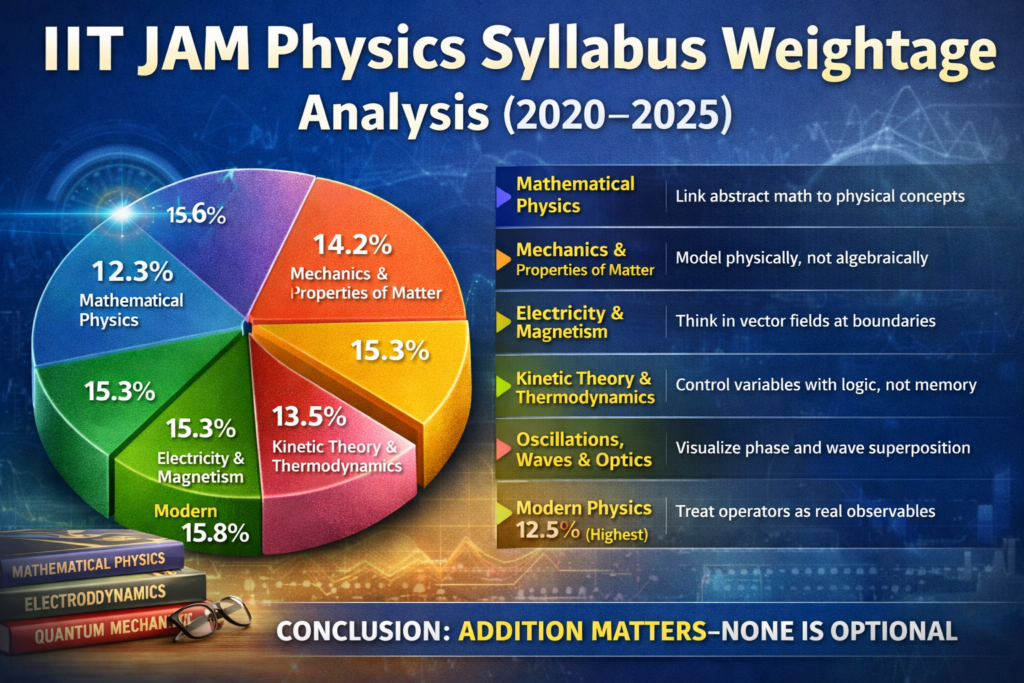
Understanding the IIT JAM Physics syllabus is not the same as reading the official syllabus document. The official document tells you which topics exist. Data from 10+ years of IIT JAM Physics papers tells you which topics matter most, how much weight each carries, how topics are interconnected, which question types each area produces, and what depth the examiners actually test. This post gives you the data-driven view — the one that separates aspirants who prepare strategically from those who cover everything equally and score unevenly.
Why Data-Driven Syllabus Understanding Changes Everything
Most aspirants approach the IIT JAM Physics syllabus the same way: they open the official brochure, see the list of topics, and begin preparing from the first topic to the last — giving roughly equal time to each. This approach treats Mathematical Physics and Modern Physics as equally important. It treats Optics and Quantum Mechanics as equivalent investments. The data shows they are not.
IIT JAM Physics papers from 2016 to 2026 reveal consistent, measurable patterns in topic weightage, question type distribution, and conceptual depth. Understanding these patterns allows you to allocate your preparation time proportionally to what the exam actually tests — maximising your score from the same total hours of preparation.
The IIT JAM Physics Syllabus: Official Topics vs Exam Reality
The official IIT JAM Physics syllabus lists seven major topic areas. But the exam does not treat them equally. Here is what PYQ analysis from 2016 to 2026 reveals about the actual mark distribution:
| Topic Area | Approx. Weightage (%) | Approx. Marks (of 100) | Priority Tier |
|---|---|---|---|
| Solid State Physics, Devices & Electronics | 19–20% | 19–20 | Tier 1 — Highest |
| Mathematical Physics | 15–16% | 15–16 | Tier 1 — Highest |
| Electricity & Magnetism (Electrodynamics) | 13–15% | 13–15 | Tier 1 — Highest |
| Oscillations, Waves & Optics | 12–14% | 12–14 | Tier 2 — High |
| Mechanics & General Properties of Matter | 10–12% | 10–12 | Tier 2 — High |
| Kinetic Theory & Thermodynamics | 10–12% | 10–12 | Tier 2 — High |
| Quantum Mechanics | 8–10% | 8–10 | Tier 2 — High |
| Modern Physics | 8–10% | 8–10 | Tier 2 — High |
Note: Weightages are based on PYQ analysis from 2016–2026 and may shift slightly year to year. The 2026 paper showed elevated Modern Physics presence (~12–14%). Always verify against the official syllabus at pravegaa.com/syllabus/iit-jam and the official JAM portal.
What the Data Reveals: Key Insights
Insight 1 — Solid State and Electronics Is the Highest-Yield Investment
At 19 to 20% consistent weightage across the last decade, Solid State Physics and Electronics is the single highest-yielding topic cluster in IIT JAM Physics. Yet it is consistently underweighted in aspirant preparation — many students treat it as a secondary topic to cover after “the main physics.” The data disagrees. A well-prepared Solid State and Electronics performance alone can secure 18 to 20 marks — equivalent to an entire mini-exam within the paper.
The sub-topics that appear most consistently across years: crystal structure (Bravais lattices, Miller indices, X-ray diffraction), semiconductor physics (p-n junction, diode characteristics, Hall effect), digital electronics (Boolean algebra, logic gates, adder and subtractor circuits), and band theory (energy bands, effective mass, distinction between metals, semiconductors, and insulators).
Insight 2 — Mathematical Physics Is a Force Multiplier
Mathematical Physics at 15 to 16% weightage is not just a standalone topic — it is the language every other topic is written in. Weak linear algebra creates problems in Quantum Mechanics. Weak vector calculus creates problems in Electrodynamics. Weak differential equations create problems in Classical Mechanics and Thermodynamics. Mathematical Physics is the only topic in the syllabus where weakness propagates directly into every other topic area.
Data-driven preparation treats Mathematical Physics as the foundational investment — not as “part of the syllabus” to be treated equally with other topics, but as the prerequisite without which other topics cannot be fully mastered. The sub-topics with highest PYQ frequency: eigenvalues and eigenvectors, vector calculus (Stokes’ and Gauss’s theorems), contour integration and residue theorem, and Fourier series.
Insight 3 — No Topic Can Be Skipped Entirely
Unlike some competitive exams where aspirants can skip entire sections, IIT JAM Physics rewards balanced preparation. Every topic in the official syllabus has appeared across multiple years in all three section types — MCQ, MSQ, and NAT. Aspirants who skip Modern Physics lose 8 to 10 marks. Aspirants who skip Quantum Mechanics lose another 8 to 10 marks. The cumulative cost of skipping “low-priority” topics is often 25 to 30 marks — which is the difference between a competitive rank and failing to qualify.
The correct data-driven approach is not to skip topics — it is to prioritise depth. Tier 1 topics get the most time because they carry the most marks. Tier 2 topics get adequate time to achieve solid understanding. No topic is skipped entirely.
Insight 4 — The Syllabus Is Deeply Interconnected, Not Modular
One of the most important things data reveals about the IIT JAM Physics syllabus is its interconnected structure. Topics are not independent modules — they form a dependency chain:
- Mathematical Physics → Quantum Mechanics: Linear algebra (eigenvalues, Hermitian operators) is the mathematical foundation of quantum mechanics. QM questions become impossible without this foundation.
- Mathematical Physics → Electrodynamics: Vector calculus is the language of Maxwell’s equations. Stokes’ and Gauss’s theorems are used directly in EMT derivations.
- Classical Mechanics → Quantum Mechanics: Canonical quantisation, Hamilton’s formulation, and symmetry principles all connect classical and quantum mechanics at the IIT JAM level.
- Thermodynamics → Statistical Mechanics: The laws of thermodynamics and entropy formulations are prerequisites for partition functions and the Boltzmann distribution.
- Electrodynamics → Modern Physics: Electromagnetic wave equations underpin the photoelectric effect, Compton scattering, and relativistic energy-momentum relations.
Understanding these dependencies tells you the correct preparation sequence — not just which topics to prioritise, but in which order to study them so that each topic reinforces the next.
The Data-Driven Preparation Sequence for IIT JAM Physics
Based on weightage data and topic interconnections, here is the preparation sequence that produces the most efficient score-building:
Phase 1 — Foundation (Months 1–3)
- Mathematical Physics — build this first because it unlocks QM, EMT, and Mechanics simultaneously. Prioritise: linear algebra, vector calculus, complex analysis, differential equations.
- Classical Mechanics — Newton’s laws, central force motion, Lagrangian formulation, oscillations. Mechanics provides physical intuition that benefits every other topic.
- Electricity and Magnetism — build on Mathematical Physics foundations. Electrostatics → Magnetostatics → Maxwell’s equations → EM waves. Use Griffiths as the primary text.
Phase 2 — Core Physics (Months 3–6)
- Quantum Mechanics — requires Mathematical Physics foundation from Phase 1. Schrödinger equation, standard systems, operators, spin, perturbation theory.
- Thermodynamics and Statistical Mechanics — kinetic theory, laws of thermodynamics, Maxwell relations, partition functions. Standalone topic cluster with manageable prerequisites.
- Oscillations, Waves, and Optics — connects to Mechanics (oscillations) and Electrodynamics (wave optics). SHM, wave equation, interference, diffraction, polarisation.
Phase 3 — High-Yield Completion (Months 6–9)
- Solid State Physics and Electronics — highest weightage topic. Crystal structure, band theory, semiconductors, digital circuits, op-amps. Allocate more time than the official syllabus length suggests — these marks are achievable and consistent.
- Modern Physics — special relativity, photoelectric effect, Compton scattering, nuclear physics basics, atomic structure. Elevated presence in 2026 paper makes this a growing priority for 2027.
Topic-Wise PYQ Frequency Analysis (2016–2026)
Beyond overall weightage, the data reveals which specific sub-topics within each area have appeared most consistently across years. These are the highest-frequency PYQ patterns — the specific topics that IIT JAM examiners return to year after year:
| Topic | Highest-Frequency Sub-Topics | Most Common Section |
|---|---|---|
| Mathematical Physics | Eigenvalues/eigenvectors, vector calculus (Stokes/Gauss), complex contour integrals, Fourier series | Section A (MCQ) + Section C (NAT) |
| Electrodynamics | Maxwell’s equations, boundary conditions, EM wave propagation, Poynting vector, Laplace/Poisson equations | Section A (MCQ) + Section C (NAT) |
| Solid State | Bravais lattices, Miller indices, Bragg’s law, band structure, semiconductor p-n junction | Section A (MCQ) + Section B (MSQ) |
| Electronics | Boolean algebra, logic gates (AND/OR/NAND), half adder, op-amp gain, diode circuits | Section A (MCQ) + Section C (NAT) |
| Quantum Mechanics | Infinite square well, harmonic oscillator energy levels, hydrogen atom, commutators, uncertainty principle | Section A (MCQ) + Section C (NAT) |
| Classical Mechanics | Central force motion, Kepler’s laws, moment of inertia, Lagrangian equations, SHM | Section A (MCQ) + Section C (NAT) |
| Thermodynamics | Carnot cycle, entropy, Maxwell relations, kinetic theory mean free path, equipartition theorem | Section C (NAT) heavy |
| Optics | Young’s double slit (fringe width), single slit diffraction, Malus’s law, Newton’s rings | Section A (MCQ) + Section C (NAT) |
| Modern Physics | Photoelectric effect, Compton scattering, Bohr model energy levels, radioactive decay law, special relativity | Section A (MCQ) + Section C (NAT) |
Section-Wise Syllabus Distribution: Which Topics Appear Where
Understanding not just what is tested but how it is tested by section type allows you to prepare differently for different question formats within the same topic:
| Section | Type | Topics That Dominate | What It Tests |
|---|---|---|---|
| Section A (MCQ) | Single correct, 30 questions, 50 marks | All topics — heaviest in E&M, Math Physics, QM, Solid State | Conceptual clarity, option elimination, physical reasoning |
| Section B (MSQ) | Multiple correct, 10 questions, 20 marks | Solid State, QM, Mechanics, Thermodynamics | Deep understanding — all correct options must be identified |
| Section C (NAT) | Numerical answer, 20 questions, 30 marks | Thermodynamics, Math Physics, Mechanics, Modern Physics, Electronics | Precise calculation, unit handling, dimensional accuracy |
The NAT section’s dominance by calculation-heavy topics (Thermodynamics, Mathematical Physics, Mechanics) means these areas have a double value — they appear in MCQs for conceptual questions and in NATs for numerical ones. Preparing these topics to calculation depth (not just conceptual understanding) directly increases Section C performance, which has no negative marking.
How IIT JAM Physics Syllabus Overlaps with CSIR NET, GATE, and JEST
One of the most strategically valuable insights from syllabus data is how the IIT JAM Physics syllabus relates to other major physics exams. Aspirants who understand this overlap can prepare for multiple exams simultaneously without duplicating effort:
| Exam | Overlap with IIT JAM Physics | Additional Topics Beyond IIT JAM | Depth Relative to IIT JAM |
|---|---|---|---|
| GATE Physics | ~85–90% | Experimental Physics, Atomic & Molecular Physics depth | Similar — both at BSc/MSc boundary |
| CSIR NET Part B | ~75–80% | Atomic & Molecular Physics, Nuclear Physics depth | Deeper — MSc level |
| CSIR NET Part C | ~50–60% | Condensed Matter, Particle Physics, Advanced QM | Research level — significantly deeper |
| JEST Physics | ~70–75% | Advanced Condensed Matter, Astrophysics basics | Deeper than IIT JAM — closer to CSIR NET Part C |
| TIFR GS | ~55–65% | Advanced QM, Statistical Physics, Particle Physics | Research level — hardest of all |
The practical implication: strong IIT JAM Physics preparation builds the foundation for GATE Physics (almost directly transferable) and for CSIR NET Part B (with additional depth). It also provides the conceptual base for JEST and TIFR, though those exams require significantly deeper treatment of core topics. Read Pravegaa’s detailed analysis of how IIT JAM 2025 paper trends project into 2026 and 2027 at the IIT JAM 2025 paper analysis page.
How to Use This Data in Your Preparation
Step 1 — Allocate Study Time Proportionally to Weightage
If Solid State and Electronics carries 20% of the paper and Modern Physics carries 8%, your preparation time allocation should reflect this — not be uniform across all topics. A simple starting ratio: for every 10 hours spent on Modern Physics, allocate 25 hours to Solid State and Electronics and 20 hours to Mathematical Physics.
Step 2 — Follow the Dependency Chain in Your Sequence
Prepare topics in the order that respects their dependencies: Mathematical Physics → Mechanics → Electrodynamics → Quantum Mechanics → Thermodynamics → Solid State → Modern Physics → Optics and Waves. This sequence ensures that each topic has the prerequisites in place when you reach it — preventing the situation where a topic feels impossible because an earlier prerequisite was skipped or underbuilt.
Step 3 — Use PYQ Data to Guide Within-Topic Priorities
Within each topic, not all sub-topics are equally tested. The PYQ frequency table above shows which sub-topics appear most consistently. Use this to guide which aspects of each topic to prioritise within your available preparation time. In Mathematical Physics, prioritise eigenvalues and vector calculus over, say, tensors — because PYQ data shows the former appears far more frequently. Download the complete IIT JAM Physics PYQ papers from Pravegaa’s free PYQ page and do your own frequency count as you prepare.
Step 4 — Prepare NAT-Heavy Topics to Calculation Depth
Topics that appear heavily in Section C — Thermodynamics, Mathematical Physics, Mechanics, Modern Physics — must be prepared not just to conceptual understanding but to reliable numerical calculation ability. This means practising unit handling, dimensional analysis as verification, and multi-step calculations under time pressure. Section C has no negative marking — every question in these topics you can approach is worth attempting.
Step 5 — Benchmark Against PYQ Standards, Not Textbook Exercises
Standard textbook exercises are often easier or differently structured than IIT JAM questions. The correct calibration tool is PYQs — attempted under timed conditions, analysed for which specific aspects of each topic they probe, and used to identify gaps between your textbook understanding and the exam standard. Integrate PYQ practice from day one, not as a final revision activity. Free topic-wise study material to complement PYQ practice is available at pravegaa.com/free-study-material.
Common Mistakes in Reading the IIT JAM Physics Syllabus
- Treating the official syllabus document as a preparation guide. The official syllabus tells you what exists — not what matters most. Use PYQ data to convert the syllabus into a weighted preparation plan.
- Equating topic count with topic importance. Modern Physics has more listed sub-topics than Quantum Mechanics in some versions of the syllabus — but QM carries more examination marks. Topic count and examination weight are different things.
- Ignoring the Solid State and Electronics cluster. At 20% of the paper, this is the most consistently underweighted topic in aspirant preparation and the most consistently over-represented in the actual exam.
- Treating Mathematical Physics as peripheral. Because Mathematical Physics is presented as a separate topic rather than the cross-cutting foundation it is, many aspirants underinvest in it — then struggle in QM, EMT, and Mechanics simultaneously.
- Assuming topic difficulty equals topic importance. Quantum Mechanics may feel harder than Optics — but the exam awards similar marks for each. Difficulty should inform preparation method (more time, more active problem solving), not priority ranking.
Frequently Asked Questions — IIT JAM Physics Syllabus
Has the IIT JAM Physics syllabus changed recently?
The official IIT JAM Physics syllabus has remained largely stable across recent years — the core seven topic areas and their sub-topics have not changed substantially. What changes year to year is the weightage distribution within the paper: which topics appear more heavily in a given year, and whether the paper leans toward conceptual MCQs or calculation-intensive NATs. Always download the official syllabus from the current year’s JAM portal (for 2027, this will be at the conducting IIT’s official JAM page) and compare against the previous year to identify any changes. For preparation purposes, combine the official syllabus with the PYQ-based weightage data on this page.
Is Quantum Mechanics underweighted in IIT JAM compared to CSIR NET?
Yes — significantly. In IIT JAM, Quantum Mechanics carries approximately 8 to 10% of the paper. In CSIR NET Part C, Quantum Mechanics is among the highest-weighted sections and is tested at a substantially deeper level. If you are preparing for both IIT JAM and CSIR NET, the CSIR NET depth of Quantum Mechanics will be your ceiling — IIT JAM will be comfortably covered within that preparation. See Pravegaa’s comprehensive long-horizon preparation guide at pravegaa.com/prepare-iit-jam-physics-exam.
Which topic in IIT JAM Physics should I start with?
Mathematical Physics — always. It is the foundation every other topic builds on. Without solid linear algebra and vector calculus, Quantum Mechanics and Electrodynamics will both be harder than they need to be. Starting with Mathematical Physics and building it properly produces a compounding return across the rest of the syllabus that no other starting point can match.
How many months does it take to cover the full IIT JAM Physics syllabus?
With structured daily preparation, the complete IIT JAM Physics syllabus can be covered to exam depth in 6 to 9 months. This allows time for: Phase 1 foundation topics (2 to 3 months), Phase 2 core physics topics (2 to 3 months), Phase 3 high-yield completion and mock practice (2 to 3 months). Aspirants starting 12 to 18 months before the exam have the advantage of adequate time for deep coverage and multiple revision cycles. Aspirants starting in the final 60 days need a compressed strategy — see Pravegaa’s 60-day IIT JAM strategy guide.
Is the IIT JAM Physics syllabus the same as the BSc Physics curriculum?
The IIT JAM Physics syllabus is drawn from BSc Physics at the Honours level — it covers the same broad topics as a standard BSc Physics Honours degree. However, the depth and question style are specifically calibrated to test whether you can apply that knowledge under exam conditions, not merely recall it. Many BSc Physics students who know the material at a course level find that IIT JAM tests it at a significantly more problem-solving-intensive level. The overlap is high, but additional exam-specific problem practice beyond coursework is essential.
Where can I download the official IIT JAM Physics syllabus PDF?
The official IIT JAM Physics syllabus PDF is available at the conducting IIT’s official JAM portal — for 2027, this will be published at the IIT conducting the exam for that year. Pravegaa also provides a complete unit-wise syllabus breakdown with preparation guidance at pravegaa.com/syllabus/iit-jam. For PYQ papers that reflect the actual exam standard, download free papers from 2016 to 2026 at pravegaa.com/iit-jam-physics-question-paper.
Build Preparation Around the Syllabus Data — With Pravegaa
At Pravegaa, our IIT JAM Physics programmes are structured around exactly the data presented on this page — topic weightage, PYQ frequency, dependency chains, and section-type distribution. Every class, every problem set, and every test series is calibrated to what the exam actually tests, not to a uniform coverage of the official document.
- IIT JAM Physics Syllabus — Complete Topic-Wise Guide — unit-wise breakdown with high-yield topic hints and preparation guidance
- IIT JAM Physics PYQ Papers (Free) — official papers 2016 to 2026 for data-driven preparation calibration
- IIT JAM Physics Online Live Course — concept-first live preparation built around syllabus weightage and PYQ analysis
- IIT JAM Physics Test Series — All India Rank, topic-wise and full mock tests calibrated to actual paper distribution
- Free Physics Study Material — topic-wise PDFs aligned to the IIT JAM Physics syllabus with PYQ integration
- IIT JAM 60-Day Strategy Guide — compressed preparation blueprint using the weightage data on this page
- How to Prepare for IIT JAM Physics 2027 & 2028 — long-horizon, research-oriented preparation strategy
