Updated 17 November 2026. The CSIR NET Physics (Physical Sciences) December 2026 exam is scheduled for 19, 22 and 27 December 2026 in CBT mode. Registration and the correction window have closed; the city intimation slip and admit card are awaited on csirnet.nta.nic.in.
CSIR NET Physics — officially the Joint CSIR-UGC NET in Physical Sciences — is the exam that decides whether a physics postgraduate gets a Junior Research Fellowship (JRF), Assistant Professor eligibility, or PhD admission eligibility. It is a 200-mark, three-hour paper in which half the score sits in a single section, and every wrong answer costs a quarter of its marks. This guide gives you the facts in one place and then does something most CSIR NET Physics pages do not: it works out the marks arithmetic so you can plan exactly how many questions to attempt, and where.
IN THIS GUIDE
What Is CSIR NET Physics?
CSIR NET Physics is the Physical Sciences paper of the Joint CSIR-UGC National Eligibility Test, conducted by the National Testing Agency (NTA) twice a year, in a June and a December cycle. One paper, one score, three possible outcomes depending on your marks and rank:
- JRF (Junior Research Fellowship): a funded route into a PhD. Recent reporting puts the JRF stipend at ₹37,000 per month for the first two years. An upper age limit applies for JRF, with category relaxations — always confirm the limit in the current Information Bulletin.
- Assistant Professor / Lectureship eligibility: no upper age limit.
- PhD admission eligibility: the newest category, for candidates who clear the qualifying threshold but fall below the JRF and Assistant Professor cut-offs.
How competitive is it? In the June 2026 cycle, 27,791 candidates registered for Physical Sciences and 21,810 appeared, according to the NTA statistics published with the result. Only a small fraction of them get a JRF, which is why preparation for CSIR NET Physics has to target rank, not just qualification.
CSIR NET Physics December 2026: Important Dates
| Event | Date |
|---|---|
| Online application | 7 October – 5 November 2026 (closed) |
| Late-fee window | 6 – 9 November 2026 (closed) |
| Correction window | 10 – 12 November 2026 (closed) |
| City intimation slip & admit card | To be announced by NTA |
| Exam dates | 19, 22 & 27 December 2026 |
| Shift timings | 9:00 am – 12:00 noon & 3:00 pm – 6:00 pm |
Your subject-wise date and shift will appear on the city intimation slip. Earlier NTA cycles placed Physical Sciences in the afternoon shift, but plan for both until the slip is out.
CSIR NET Physics Exam Pattern and Marking Scheme
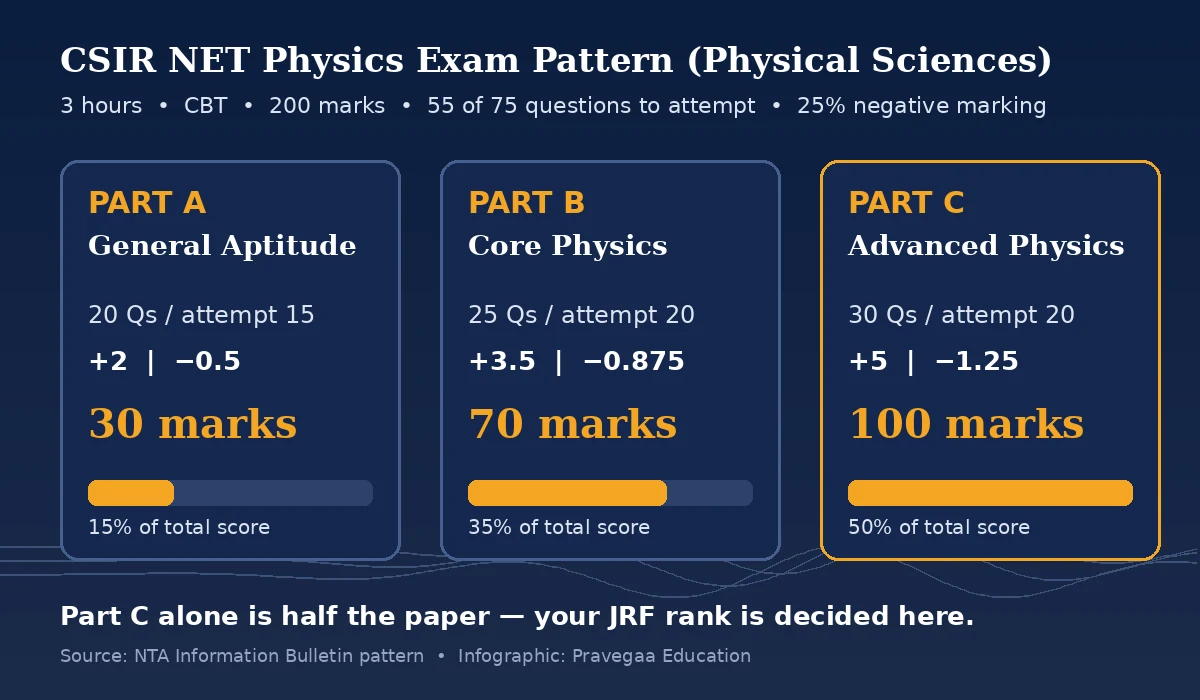
| Section | Questions | Attempt | Correct | Wrong | Max marks |
|---|---|---|---|---|---|
| Part A – General Aptitude | 20 | 15 | +2 | −0.5 | 30 |
| Part B – Core Physics | 25 | 20 | +3.5 | −0.875 | 70 |
| Part C – Advanced Physics | 30 | 20 | +5 | −1.25 | 100 |
| Total | 75 | 55 | — | 25% | 200 |
The paper runs for 180 minutes, in English and Hindi. Two facts shape strategy more than anything else: Part C is worth as much as Parts A and B combined, and the penalty for a wrong answer is exactly 25% of that question’s value in every section. A proposal to restructure the syllabus and introduce Numerical Answer Type (NAT) questions was published in April 2026; it remains a proposal, and we have analysed what it could mean in our NAT pattern analysis.
CSIR NET Physics Syllabus at a Glance
Part B (Core) and Part C (Advanced) test the same broad subjects; Part C goes deeper and adds four specialised units.
Core units (Part B & C)
- Mathematical Methods of Physics
- Classical Mechanics
- Electromagnetic Theory
- Quantum Mechanics
- Thermodynamics & Statistical Physics
- Electronics & Experimental Methods
Advanced-only units (Part C)
- Atomic & Molecular Physics
- Condensed Matter Physics
- Nuclear & Particle Physics
- Advanced treatment of all core units
For the full sub-topic list, see the CSIR NET Physics Syllabus unit-wise guide.
The CSIR NET Physics Score Blueprint: How Many Questions Should You Attempt?
Most aspirants set a vague goal (“I’ll attempt as many as I can”). A better approach is to fix a target, then work backwards to the number of correct answers you need in each part, allowing for a realistic number of mistakes. The three plans below are computed exactly with the official marking scheme.
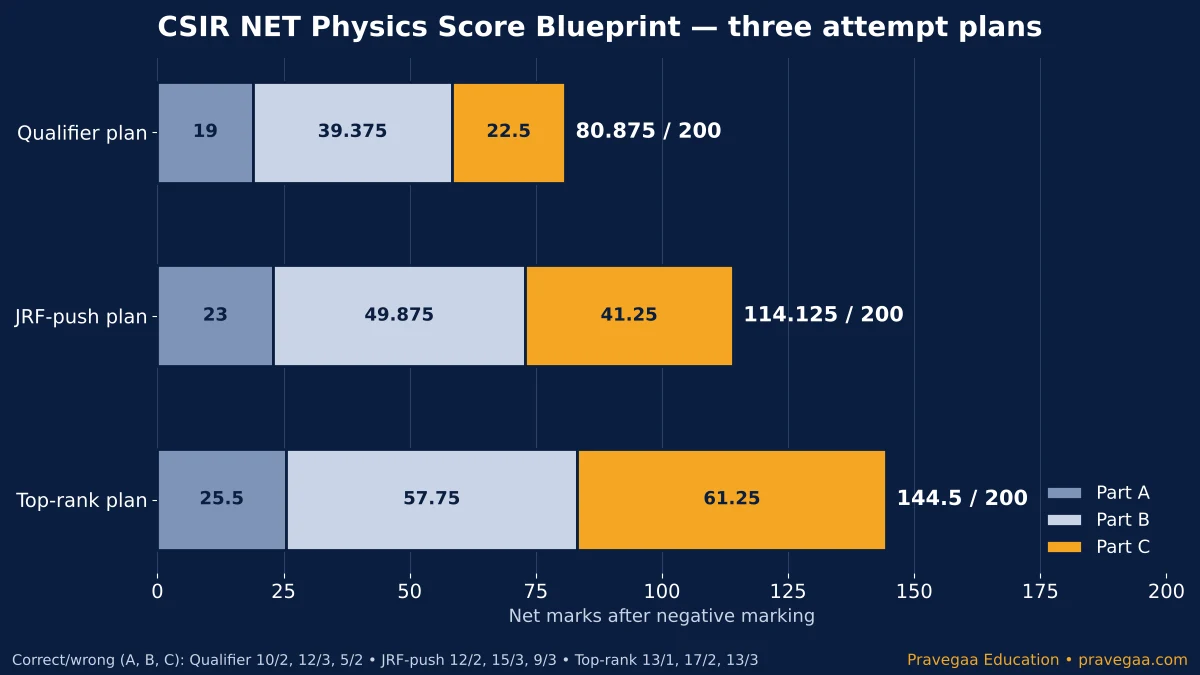
| Plan | Part A (✓/✗) | Part B (✓/✗) | Part C (✓/✗) | Net score |
|---|---|---|---|---|
| Qualifier | 10 / 2 → 19 | 12 / 3 → 39.375 | 5 / 2 → 22.5 | 80.875 |
| JRF-push | 12 / 2 → 23 | 15 / 3 → 49.875 | 9 / 3 → 41.25 | 114.125 |
| Top-rank | 13 / 1 → 25.5 | 17 / 2 → 57.75 | 13 / 3 → 61.25 | 144.5 |
What the blueprint tells you:
- The jump from qualifier to JRF-push is mostly Part C. Moving from 5 to 9 correct Part C answers adds 18.75 net marks — more than the gain from Part A and Part B together.
- Part B is the stabiliser. 15 correct Part B answers (75% of the attempt limit) gives almost 50 marks and protects you on a hard Part C day.
- Part A is cheap marks, but capped. Even a perfect Part A is only 30 marks. Spend about 25–30 minutes on it and move on.
Treat these as planning targets, not cut-off predictions. Category-wise cut-offs change every cycle — check the official result notice for the last cycle’s numbers. NTA’s qualifying criterion also applies a minimum aggregate percentage (33% for General/EWS/OBC and 25% for SC/ST/PwD in recent bulletins) before ranks are considered.
Test your blueprint before the real exam
Pravegaa’s CSIR NET Physics Test Series follows the exact Part A/B/C pattern, with an all-India rank after each mock.
Negative Marking in CSIR NET Physics: When Should You Attempt a Doubtful Question?
Because the penalty is 25% and each question has four options, the expected value of an answer depends on how many options you can eliminate. For a Part C question (+5 / −1.25):
| Options left after elimination | Expected marks (Part C) | Expected marks (Part B) |
|---|---|---|
| 4 (pure guess) | +0.31 | +0.22 |
| 3 | +0.83 | +0.58 |
| 2 | +1.88 | +1.31 |
Mathematically, even a blind guess is slightly positive. But there is a catch: you can attempt only 20 questions in Part C. Every slot spent on a guess is a slot not spent on a question you could solve. The practical rule we teach at Pravegaa:
- First pass: attempt every question you can solve with confidence.
- Second pass: use remaining attempt slots on questions where you can eliminate two options using limiting cases, dimensions or symmetry — expected gain nearly 1.9 marks each in Part C.
- Avoid pure guesses unless slots are left with under five minutes to go.
Dimensional analysis and limiting-case checks are physics skills, not exam tricks — which is why conceptual clarity pays off directly in the score.
CSIR NET Physics: 30-Day Final Roadmap for December 2026
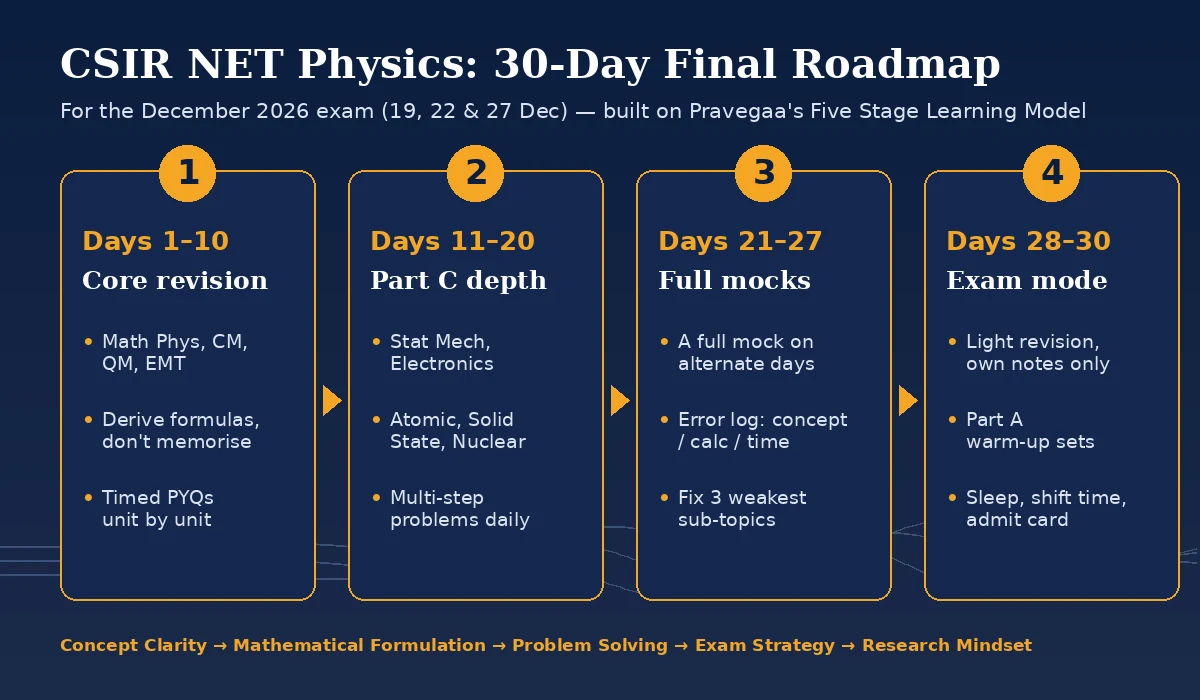
With roughly a month to the first exam date, this is not the time to start new books. The roadmap follows our Five Stage Learning Model — Concept Clarity → Mathematical Formulation → Problem Solving → Exam Strategy → Research Mindset — compressed into the final stretch.
Days 1–10: Core revision
Revise Mathematical Physics, Classical Mechanics, Quantum Mechanics and Electromagnetic Theory — they feed both Part B and Part C. Re-derive key results (Green’s functions, Lagrangian/Hamiltonian forms, perturbation theory, boundary-value problems) instead of reading formula lists. Solve previous-year questions unit by unit, under time.
Days 11–20: Part C depth
Move to Statistical Mechanics, Electronics, Atomic & Molecular, Condensed Matter and Nuclear Physics. These units often reward short, standard derivations — partition functions, op-amp circuits, selection rules, band structure, binding energy. Do multi-step problems daily.
Days 21–27: Full-length mocks
Take a full mock on alternate days in your exam shift timing. Keep an error log with three columns — concept, calculation, time — and fix the three weakest sub-topics on the days between mocks.
Days 28–30: Exam mode
Light revision from your own notes, a few Part A warm-up sets, a fixed sleep schedule, and admit-card logistics. For a longer, week-by-week plan, read our CSIR NET Physical Sciences December 2026 preparation guide.
Best Books and Free Resources for CSIR NET Physics
| Subject | Standard references |
|---|---|
| Mathematical Physics | Arfken & Weber; Boas |
| Classical Mechanics | Goldstein; Upadhyaya |
| Electromagnetic Theory | Griffiths |
| Quantum Mechanics | Griffiths; Zettili; Sakurai |
| Statistical Physics | Pathria; Reif |
| Electronics | Malvino; Millman & Halkias |
| Solid State / Nuclear | Kittel; Krane |
Free resources from Pravegaa that map to the CSIR NET Physics syllabus:
- 106 chapter-wise CSIR NET Physics notes (also on the Pravegaa Physics Library)
- Previous year question papers
- Formula sheets and solved problems
- Free class tests and video lectures
Why Aspirants Prepare for CSIR NET Physics with Pravegaa
Pravegaa Education is a physics-only institute near IIT Delhi, founded and directed by Atul Gaurav (JNU alumnus; Quantum Mechanics, Mathematical Physics, Classical Mechanics) and Dr. Alok Shukla (IIT Delhi alumnus; Electrodynamics, Statistical Mechanics). Over 15+ years, the institute has recorded 8,000+ selections, including multiple AIR 1 results — see CSIR NET Physics results. Programmes include online live classes, offline classroom coaching in Delhi, recorded courses, a crash course and correspondence study material.
Not sure where you stand?
Attend a free demo class or speak to our academic team: 89207 59559 / 80765 63184
CSIR NET Physics: Frequently Asked Questions
When is the CSIR NET Physics December 2026 exam?
The Joint CSIR-UGC NET December 2026 is scheduled for 19, 22 and 27 December 2026 in CBT mode. Your Physical Sciences date and shift will be shown on the city intimation slip released by NTA.
What is the CSIR NET Physics exam pattern?
75 questions across Part A (20), Part B (25) and Part C (30), of which you attempt 55 (15 + 20 + 20). Marks per correct answer are 2, 3.5 and 5 respectively, for a total of 200 marks in 3 hours.
Is there negative marking in CSIR NET Physics?
Yes. A wrong answer costs 25% of the question’s marks: 0.5 in Part A, 0.875 in Part B and 1.25 in Part C. Unattempted questions score zero.
How many marks are needed to get JRF in CSIR NET Physics?
There is no fixed number; JRF is awarded on rank and category-wise cut-offs that change each cycle. As a planning target, our score blueprint shows that roughly 110+ net marks needs about 9 correct Part C answers alongside a strong Part B.
Which part of CSIR NET Physics is most important?
Part C carries 100 of the 200 marks, so it decides most JRF ranks. Part B provides stability, and Part A offers quick but capped marks.
Can I prepare for CSIR NET Physics in one month?
One month is enough to consolidate, practise PYQs and take mocks, but not to learn the full syllabus from scratch. Use the 30-day roadmap above to maximise marks from what you already know.
Official references: csirnet.nta.nic.in · nta.ac.in · csirhrdg.res.in. Always verify dates and eligibility in the latest NTA Information Bulletin.