Understanding the IIT JAM Physics Syllabus Through Data
A Topic-Wise Editorial Analysis (2020–2025)
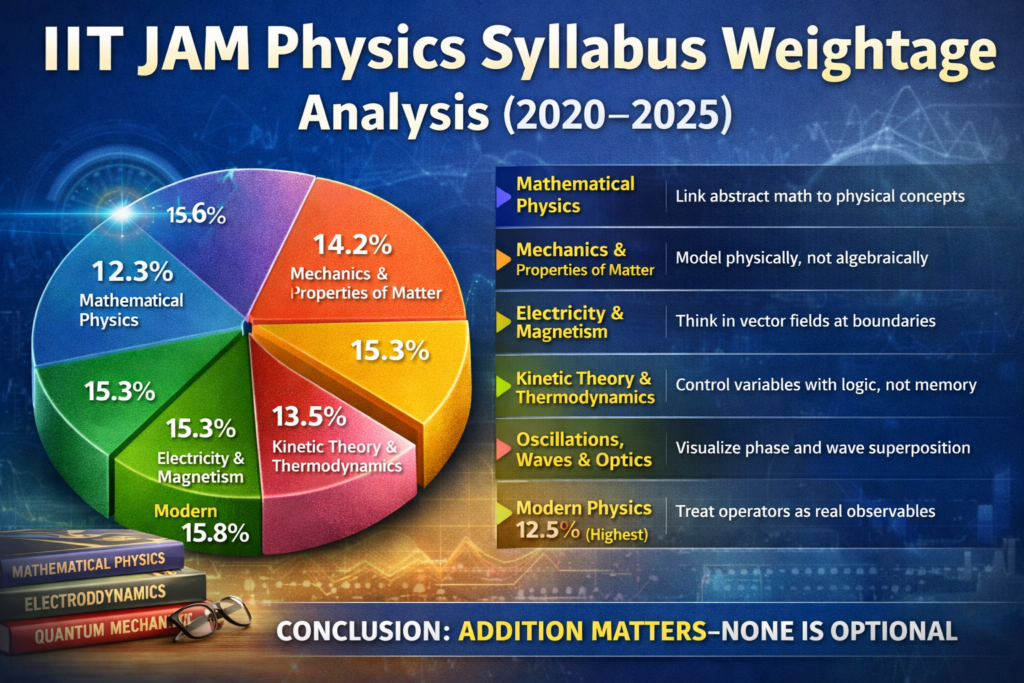
For a serious IIT JAM Physics aspirant, the syllabus is not a list of chapters to be completed—it is a map of intellectual priorities. When the last six IIT JAM Physics papers (2020–2025, 600 marks total) are visualized as a pie diagram, an important truth emerges:
IIT JAM Physics is structurally balanced, but analytically selective.
Each topic occupies a clearly defined share of the paper, and that share corresponds to a specific mode of physical thinking. Ignoring this structure leads to inefficient preparation, no matter how hard one studies.
Below is a topic-wise editorial breakdown, strictly following the official IIT JAM Physics syllabus order, including weightage, conceptual theme, common student errors, and the correct preparation strategy for each block.
1. Mathematical Physics
Weightage: ~12.3% (74 / 600 marks)
Content
Calculus of single and multiple variables, partial derivatives, Jacobians, Taylor expansion, Fourier series, vector algebra and vector calculus, multiple integrals, Green’s, Gauss’s and Stokes’ theorems, differential equations, matrices, determinants, and complex numbers.
Core Theme
Mathematical Physics is the language layer of IIT JAM. It is not tested as an independent subject, but as the medium through which all other physics is expressed.
Common Student Errors
-
Studying mathematics in isolation
-
Weak vector intuition (∇ treated symbolically)
-
Treating matrices as determinant problems
-
Memorizing theorems without physical interpretation
Correct Strategy
-
Attach every mathematical tool to a physical application
-
Use vector calculus actively in EM and fluid mechanics
-
Treat matrices as operators acting on states
-
Practice coordinate transformations with Jacobians in real systems
A strong foundation here quietly boosts performance across the entire paper.
2. Mechanics & General Properties of Matter
Weightage: ~14.2% (85 / 600 marks)
Content
Newton’s laws, motion in Cartesian, polar and cylindrical coordinates, rotating frames, centrifugal and Coriolis forces, central force motion, conservation laws, rigid body dynamics, moments of inertia, and elementary fluid mechanics.
Core Theme
Mechanics in IIT JAM tests physical modeling discipline, not algebraic speed.
Common Student Errors
-
Writing equations before choosing a reference frame
-
Poor or missing free-body diagrams
-
Confusion in polar and rotating coordinates
-
Memorizing fictitious forces without understanding origin
Correct Strategy
-
Always begin with frame and coordinate selection
-
Draw free-body diagrams carefully, especially in non-inertial frames
-
Use conservation laws as consequences of symmetry
-
Treat central force problems as angular-momentum problems first
Most mistakes in mechanics are conceptual, not mathematical.
3. Electricity & Magnetism
Weightage: ~15.3% (92 / 600 marks)
Content
Electrostatics, Gauss’s law, electric fields and potentials, boundary conditions, Laplace’s equation, capacitors and dielectrics, magnetostatics, electromagnetic induction, AC circuits, Maxwell’s equations, EM waves, and Lorentz force.
Core Theme
Electricity & Magnetism is examined as a vector field theory governed by symmetry and boundary conditions.
Common Student Errors
-
Applying Gauss’s law without checking symmetry
-
Treating fields as scalars
-
Ignoring boundary conditions at interfaces
-
Memorizing Maxwell’s equations without interpretation
Correct Strategy
-
Identify symmetry before selecting equations
-
Think in terms of fields, not charges and currents
-
Practice boundary-value problems deliberately
-
Understand Maxwell’s equations conceptually before using them
EM rewards conceptual clarity more than calculation length.
4. Kinetic Theory & Thermodynamics
Weightage: ~13.5% (81 / 600 marks)
Content
Kinetic theory of gases, velocity distributions, equipartition theorem, laws of thermodynamics, entropy, Carnot cycle, Maxwell relations, thermodynamic potentials, and phase transitions.
Core Theme
Thermodynamics tests logical control over variables.
Common Student Errors
-
Confusing state variables and path variables
-
Misusing partial derivatives
-
Memorizing Maxwell relations without understanding constraints
-
Treating entropy as an algebraic quantity
Correct Strategy
-
Be explicit about independent and dependent variables
-
Always identify what is held constant
-
Interpret thermodynamic potentials physically
-
Use diagrams for thermodynamic processes
Precision in reasoning is essential here.
5. Oscillations, Waves & Optics
Weightage: ~15.2% (91 / 600 marks)
Content
Simple harmonic motion, superposition, damped and forced oscillations, wave equation, standing waves, energy transport, Doppler effect, interference, diffraction, polarization, and resolving power.
Core Theme
This entire block is unified by linearity, superposition, and phase.
Common Student Errors
-
Memorizing optics formulas without wave reasoning
-
Confusing amplitude and intensity
-
Weak understanding of phase difference
-
Treating oscillations and optics as separate topics
Correct Strategy
-
Master the wave equation and its solutions
-
Visualize phase relationships before calculating
-
Use diagrams consistently
-
Treat interference and diffraction as wave-addition problems
This section is highly predictable when approached correctly.
6. Modern Physics
Weightage: ~12.5% (75 / 600 marks)
Content
Special relativity, Lorentz transformations, quantum mechanics basics, Schrödinger equation, simple potentials, atomic and nuclear physics, and radioactivity.
Core Theme
Modern Physics demands conceptual discipline and assumption control.
Common Student Errors
-
Mixing classical and relativistic reasoning
-
Ignoring boundary conditions in quantum problems
-
Confusing operators with observables
-
Over-reliance on formulas
Correct Strategy
-
Be explicit about reference frames
-
Treat operators as physical observables
-
Master infinite square well and harmonic oscillator
-
Focus on interpretation before calculation
Accuracy matters more than speed.
7. Solid State Physics, Devices & Electronics
Weightage: ~16.8% (101 / 600 marks — Highest)
Content
Crystal structure, Bravais lattices, Miller indices, X-ray diffraction, semiconductors, Fermi level, diodes, transistors, amplifiers, oscillators, op-amps, Boolean algebra, and logic gates.
Core Theme
This section bridges fundamental physics and real-world systems and often acts as a rank separator.
Common Student Errors
-
Neglecting crystal structures
-
Treating electronics as circuit memorization
-
Weak understanding of semiconductor physics
-
Ignoring digital electronics
Correct Strategy
-
Give proper time to crystal structures and reciprocal space
-
Understand band theory before devices
-
Apply Kirchhoff’s laws as conservation principles
-
Analyze circuits functionally, not procedurally
This section consistently offers high-value scoring opportunities.
Editorial Conclusion: What the Pie Diagram Makes Clear
Viewed as a pie diagram, the IIT JAM Physics syllabus shows no optional region. Every slice contributes meaningfully, and each slice tests a distinct analytical skill.
The exam rewards students who:
-
Respect weightage
-
Understand thematic intent
-
Avoid common conceptual traps
-
Prepare analytically rather than selectively
At Pravegaa Education, this data-driven interpretation of the syllabus guides mentorship and course design—because the syllabus is not random, and neither is success.
Frequently Asked Questions (FAQ)
IIT JAM Physics Syllabus & Preparation Strategy
1. Is the IIT JAM Physics syllabus really balanced across all topics?
Yes. Analysis of the 2020–2025 papers shows that each topic consistently contributes 12–17% of the paper.
2. Which topic has the highest weightage in IIT JAM Physics?
Solid State Physics, Devices & Electronics (~16.8%), making it a frequent rank separator.
3. Should I start IIT JAM preparation with Mathematical Physics?
Yes—but alongside core subjects so mathematics gains physical meaning.
4. Why do many students struggle in Mechanics despite practice?
Most errors arise from incorrect physical modeling, not lack of practice.
5. Is Electricity & Magnetism calculation-heavy in IIT JAM?
No. It emphasizes symmetry, boundary conditions, and vector reasoning.
6. How important is Thermodynamics?
It tests logical precision and variable control, not memorization.
7. Is Optics separate from Waves in IIT JAM?
No. Both are unified through superposition and phase concepts.
8. How should I approach Modern Physics?
With strict control of assumptions, boundary conditions, and interpretation.
9. Can IIT JAM be prepared alongside graduation?
Yes, with phased planning and synchronization.
10. Biggest mistake students make?
Treating the syllabus as disconnected chapters instead of a coherent structure.
11. How does Pravegaa use syllabus analysis differently?
By aligning teaching with weightage trends and examiner intent.
12. Are PYQs enough for preparation?
Only when analyzed deeply—not solved mechanically.
