IIT JAM Physics College Parallel Hybrid Program for DU & NCR Students: Offline + Online, No Drop Year
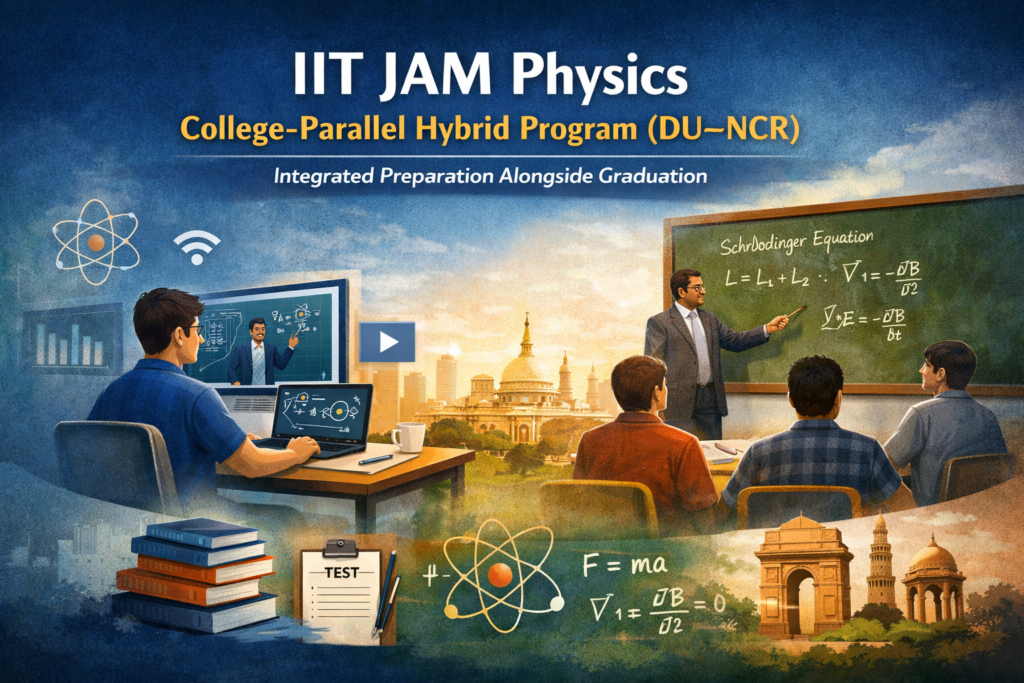
The IIT JAM Physics College Parallel Hybrid Program for DU and NCR students is Pravegaa Education’s most strategically designed course for one of India’s largest physics aspirant communities — BSc Physics students at Delhi University colleges and institutions across the NCR region who want to crack IIT JAM without taking a drop year, without commuting across Delhi every day, and without sacrificing the quality of their undergraduate education.
This is not a generic online batch with a Delhi label. It is a programme built around the specific academic calendar, geography, and preparation challenges of DU and NCR Physics students — combining the depth of in-person instruction with the flexibility of online sessions in a structure that genuinely works alongside a college schedule.
Why DU and NCR Physics Students Have a Unique Preparation Challenge
Physics students at Delhi University colleges — Hansraj, Ramjas, Hindu, Kirori Mal, Dyal Singh, ARSD, and others — face a preparation situation that is different from aspirants anywhere else in India. They are geographically close to one of India’s best physics coaching ecosystems (Jia Sarai, near IIT Delhi, is 30 to 45 minutes from most DU colleges). But they face several structural barriers that prevent them from accessing it effectively:
- DU’s academic load is substantial — the four-year BSc Honours Physics programme at DU demands consistent daily engagement with coursework, practicals, tutorials, and semester exams that leave limited bandwidth for additional preparation
- Daily commute to Jia Sarai is not feasible for most DU students — travelling from North Campus or South Campus to Hauz Khas daily would consume more time than the classes themselves
- Fully online programmes lack physical accountability — many DU students find that without any in-person component, self-discipline erodes and preparation becomes inconsistent within a few weeks
- NCR students face even greater commute barriers — students from Noida, Gurgaon, Ghaziabad, Faridabad, and other NCR cities cannot attend a Delhi classroom daily, but may be able to manage weekend visits
- The IIT JAM Physics syllabus overlaps significantly with DU Physics coursework — but only if preparation is structured to leverage this overlap rather than treating the two as separate, competing demands
Pravegaa’s College Parallel Hybrid Program (DU–NCR) is designed to solve every one of these constraints simultaneously.
What Is the IIT JAM Physics Hybrid Program DU–NCR?
The College Parallel Hybrid Program (DU–NCR) is a structured combination of:
- Weekend offline sessions at Pravegaa’s centre at 28B/7, Jia Sarai, Hauz Khas, Near IIT Delhi — for in-person concept teaching, problem solving sessions, doubt resolution, and direct faculty interaction
- Online weekday sessions — live interactive classes on weekday evenings, timed to avoid clash with DU college hours, covering the full IIT JAM Physics syllabus systematically
- Recorded backups of every session — so no class is permanently missed during DU internal exams, practicals, or other college commitments
- Regular testing — topic-wise tests and full-length mock exams integrated throughout the programme, with performance analysis and All India Rank benchmarking
- Mentorship — direct academic guidance from Pravegaa faculty to align your DU coursework preparation with your IIT JAM preparation, reducing duplication and maximising synergy
The hybrid format is the defining feature. Neither a fully offline programme (too demanding on commute time for DU students) nor a fully online programme (insufficient physical accountability for many aspirants) — the DU–NCR Hybrid sits at the optimal point between access, depth, and discipline.
The DU–IIT JAM Syllabus Overlap Advantage
One of the most underutilised advantages available to DU Physics students is the significant overlap between the Delhi University BSc Physics Honours syllabus and the IIT JAM Physics exam syllabus.
DU’s four-year BSc Physics Honours programme covers Mathematical Physics, Classical Mechanics, Electrodynamics, Quantum Mechanics, Thermodynamics and Statistical Mechanics, Solid State Physics, and Electronics — precisely the topics that constitute the IIT JAM Physics paper. A DU student who structures their coursework preparation and IIT JAM preparation together — rather than treating them as separate, competing demands — effectively prepares for both simultaneously.
The Hybrid Program is structured specifically to leverage this overlap. When you study Quantum Mechanics for your DU semester, the Hybrid Program builds IIT JAM-level depth on the same topic at the same time. When your DU coursework covers Electrodynamics, the programme integrates PYQ practice from IIT JAM Physics on the same material. The result is that your DU academic performance and your IIT JAM preparation reinforce each other — rather than competing for the same hours.
Programme Features
Weekend Offline Sessions at Jia Sarai — The In-Person Anchor
The weekend sessions at Pravegaa’s Jia Sarai centre are the physical anchor of the Hybrid Program. These sessions provide what online preparation alone cannot: direct physical presence in a focused study environment, face-to-face problem-solving interaction with faculty, and the concentration discipline that comes from being in a dedicated physics preparation space.
Jia Sarai is accessible from DU North Campus in approximately 30 to 40 minutes by metro (Yellow Line to AIIMS or Hauz Khas, then a short auto ride). From South Campus, the commute is 20 to 30 minutes. For NCR students, weekend visits eliminate the daily commute barrier while preserving the in-person learning benefit. Learn more about Pravegaa’s offline classroom setup at the offline classroom programme page.
Online Weekday Evening Sessions — Flexible Daily Preparation
Weekday evening live sessions keep preparation moving on days when commuting to Jia Sarai is not feasible. These sessions cover the IIT JAM Physics syllabus systematically — topic by topic, with concept teaching, worked examples, and PYQ analysis integrated from the start. Real-time faculty interaction during live sessions means doubts are addressed within the session rather than accumulating between meetings.
Session timings are set to avoid the standard DU lecture hours, ensuring there is no academic conflict on most days. For more on the online component and how it integrates with in-person teaching, see Pravegaa’s online live classes page.
Recorded Backup of Every Session
Every Hybrid Program session — both offline and online — is recorded and made available to enrolled students. DU students face unavoidable preparation disruptions throughout the year: internal assessment weeks, practical examination periods, semester exams, college festivals, and other commitments. The recorded backup ensures that none of these disruptions permanently removes material from your preparation — you can catch up at the next available opportunity without falling irretrievably behind.
Complete IIT JAM Physics Syllabus Coverage
The Hybrid Program covers the complete IIT JAM Physics syllabus across both its offline and online components. Every major topic cluster is addressed at IIT JAM depth:
- Mathematical Physics — vector calculus, linear algebra, complex analysis, differential equations, Fourier series
- Classical Mechanics — Newtonian mechanics, Lagrangian formulation, central force motion, rotational dynamics, oscillations
- Electricity and Magnetism — electrostatics, magnetostatics, Maxwell’s equations, electromagnetic waves
- Quantum Mechanics — Schrödinger equation, standard systems, operators, spin, perturbation theory
- Thermodynamics and Statistical Mechanics — laws of thermodynamics, entropy, Maxwell relations, partition functions
- Oscillations, Waves, and Optics — SHM, wave equation, interference, diffraction, polarisation
- Solid State Physics — crystal structure, band theory, semiconductors, superconductivity basics
- Electronics — digital circuits, Boolean algebra, op-amps, diode and transistor characteristics
- Modern Physics — special relativity, nuclear physics, atomic structure, photoelectric effect
See the complete unit-wise syllabus with high-yield topic guidance at pravegaa.com/syllabus/iit-jam.
PYQ Integration from Day One
Previous year IIT JAM Physics questions are integrated into teaching from the start of the programme — not held back as a final revision activity. This means that as each topic is taught, students immediately see how that topic is tested in IIT JAM: the question types, the depth of understanding required, and the specific aspects of the topic that the exam consistently emphasises. This approach eliminates the common disconnect between “what I have studied” and “what IIT JAM actually tests.” Download free IIT JAM Physics PYQ papers from Pravegaa’s PYQ page.
Integrated Test Series with All India Rank
The programme includes regular topic-wise tests and full-length IIT JAM pattern mock exams with All India Rank among Pravegaa’s national student pool. This benchmarking is essential for DU and NCR students who may otherwise only compare their preparation to their immediate peer group — a sample that does not reflect the national competition. Enroll in Pravegaa’s IIT JAM Physics Test Series for additional mocks and detailed performance analytics.
Study Material — Soft Copy and Hard Copy
Enrolled students receive comprehensive Pravegaa study material covering the complete IIT JAM Physics syllabus — available in both digital (soft copy) and printed (hard copy) formats. The material includes theory with derivations, worked examples, topic-wise PYQ worksheets, and formula revision sheets. A preview of the material quality is available at pravegaa.com/free-study-material.
Academic Mentorship Aligned to DU Semester Calendar
The Hybrid Program includes mentorship that accounts for the DU academic calendar specifically. Faculty guidance covers how to manage preparation intensity around DU internal assessment periods, how to leverage DU coursework topics for simultaneous IIT JAM preparation, and how to recalibrate the preparation schedule if disruptions occur during the academic year. This DU-aware mentorship structure is a feature that fully online programmes cannot replicate.
How the Hybrid Program Compares to Other Preparation Options
| Preparation Approach | Physical Access | Schedule Flexibility | Accountability | DU Compatibility |
|---|---|---|---|---|
| Full-time offline coaching (daily) | High | None — daily commute required | High | Very low — conflicts with DU schedule |
| Fully online live course | None | High — access from anywhere | Moderate | Good if evening-scheduled |
| Recorded video course | None | Maximum — fully self-paced | Low — no external discipline | Good on paper; often becomes inconsistent |
| Self-study only | None | Maximum | None | Flexible but typically very inconsistent |
| DU–NCR Hybrid Program (this) | Moderate — weekend sessions at Jia Sarai | High — weekday evenings online, weekends offline | High — in-person anchor + online structure | Optimal — built around DU calendar |
Who Should Enroll in the DU–NCR Hybrid Program?
- BSc Physics Honours students at DU colleges — North Campus (Hansraj, Ramjas, Hindu, Kirori Mal, St. Stephen’s) and South Campus (ARSD, Dyal Singh, Gargi, Venkateshwara, Sri Venkateswara) — who want structured IIT JAM preparation alongside their degree
- Physics students at NCR colleges and universities — in Noida, Gurgaon, Ghaziabad, Faridabad, Greater Noida — who can manage weekend visits to Jia Sarai but cannot commit to daily commutes
- DU students in 2nd year who want to begin IIT JAM preparation 12 to 18 months before the exam while managing their Honours coursework
- DU students in 3rd or 4th year who need to consolidate preparation in the final 6 to 9 months before IIT JAM while completing their degree requirements
- Aspirants who have tried fully online programmes and found that without physical sessions their consistency breaks down — the in-person weekend anchor addresses this directly
DU Physics Students Who Have Cleared IIT JAM with Pravegaa
Pravegaa’s verified results include multiple IIT JAM Physics selections from Delhi University students — including from Shivaji College, Ramjas College, and other DU institutions. These are students who prepared at Pravegaa alongside their BSc Honours programme, leveraging the DU–Pravegaa preparation synergy rather than treating the two as competing demands. See verified results with names, AIRs, and colleges on Pravegaa’s IIT JAM Physics results page.
The DU Physics Curriculum Advantage — and How to Use It
Delhi University’s four-year BSc Physics Honours programme is one of the most rigorous undergraduate physics curricula in India. Students who complete it emerge with a strong theoretical foundation in the same topics that IIT JAM tests — provided they engage with the coursework at the required depth rather than primarily for examination marks.
The specific DU advantage for IIT JAM preparation:
- DU’s Mathematical Physics coursework directly builds the linear algebra, complex analysis, and differential equations proficiency that IIT JAM tests in Section A and Section C
- DU’s Electrodynamics curriculum — often taught from Griffiths directly — aligns almost perfectly with the IIT JAM Electricity and Magnetism section
- DU’s Quantum Mechanics coursework covers the Schrödinger equation, operators, and standard systems that IIT JAM consistently tests in both MCQ and NAT formats
- DU’s Solid State Physics papers in the 3rd and 4th year directly build the crystal structure, band theory, and semiconductor knowledge that carries 19 to 20% of the IIT JAM paper
The Hybrid Program structures IIT JAM preparation to run in step with the DU semester calendar — so that when your DU coursework reaches a topic, your IIT JAM preparation deepens that exact topic simultaneously. This alignment is the core academic design principle of the DU–NCR programme and what makes it more efficient than either isolated IIT JAM coaching or solo DU coursework preparation.
Frequently Asked Questions — IIT JAM Physics Hybrid Program DU–NCR
How many days per week do I need to attend in person at Jia Sarai?
The Hybrid Program is structured around weekend offline sessions — typically on Saturdays, Sundays, or a combination of one or two days per weekend. The daily weekday component is online. This means most DU and NCR students need to travel to Jia Sarai only once or twice per week, which is manageable from both DU North and South Campus without disrupting weekday college attendance.
Can students from outside Delhi (Noida, Gurgaon, Ghaziabad) join this programme?
Yes — the DU–NCR Hybrid Program is specifically designed to serve NCR students who cannot commute daily to Delhi but can manage weekend sessions at Jia Sarai. Noida and Gurgaon are approximately 30 to 45 minutes from Hauz Khas; Ghaziabad and Faridabad are within 45 to 60 minutes. The weekend-only offline schedule makes the programme accessible from across the NCR region. For students where even weekend travel is not feasible, Pravegaa’s fully online CPOP programme may be the better fit.
Does the Hybrid Program follow the DU academic calendar?
Yes. The programme is structured with the DU academic calendar in mind — including reduced session intensity during DU internal assessment periods and semester examination weeks, with recorded content available to cover those gaps. Mentors help students recalibrate their preparation schedule around DU academic events without losing the overall preparation trajectory.
What if I miss a weekend offline session?
Every offline session is recorded. If a weekend session is missed due to DU commitments, illness, or other reasons, the full recording is available for review. Doubt clearing for missed sessions can be addressed in the next available doubt resolution slot — online or in the following weekend’s session. The programme is designed to absorb the unavoidable irregularities of a college academic year without penalising students who manage those irregularities well.
How does the Hybrid Program differ from the regular CPOP (online-only programme)?
The core difference is the physical component. CPOP is entirely online — live evening and weekend sessions accessible from anywhere. The DU–NCR Hybrid Program adds regular in-person weekend sessions at Jia Sarai, providing a physical learning anchor that improves concentration discipline, enables more intensive problem-solving sessions, and allows direct face-to-face faculty interaction that some aspirants find more effective than online-only engagement. For DU and NCR students who can manage the weekend commute, the Hybrid Program typically produces better preparation consistency than a purely online model.
When should a DU student ideally start the Hybrid Program?
The ideal starting point is the beginning of 2nd year BSc Physics Honours at DU — approximately 18 to 20 months before the IIT JAM exam. This allows complete syllabus coverage with genuine depth, adequate PYQ practice, multiple full-length mock exam cycles, and time for targeted remediation before the exam. Students starting in 3rd year (9 to 12 months before the exam) can also achieve competitive ranks with the right intensity. Students in their 4th year with 5 to 6 months remaining should look at Pravegaa’s crash course options alongside the Hybrid Program’s final preparation modules.
Does preparing for IIT JAM alongside DU harm semester exam performance?
When structured correctly — which is the purpose of the Hybrid Program — IIT JAM preparation strengthens DU semester performance rather than competing with it. The depth of understanding required for IIT JAM is greater than what most DU semester examinations test, meaning that IIT JAM-level preparation in a topic produces better DU results in that same topic, not worse. The risk of harm arises only when preparation is unstructured and unmanaged — which is precisely what the Hybrid Program’s calendar alignment and mentorship structure prevents. For reference, see how DU students have historically performed with Pravegaa preparation on the IIT JAM results page.
Get Started — Register for a Free Demo Class
The best way to evaluate whether the DU–NCR Hybrid Program is right for you is to experience a class before enrolling. Pravegaa offers a free demo session — online or in person at Jia Sarai — that gives you a direct experience of the teaching quality, programme structure, and faculty interaction before making any commitment.
For DU students, the demo session also includes a brief one-on-one mentorship conversation to assess your current preparation stage and map out how the Hybrid Program aligns with your specific DU semester calendar and IIT JAM target year.
- Register for Free Demo Class — experience Pravegaa teaching before enrolling; in-person or online
- CPOP — Evening & Weekend Online Programme — fully online alternative for students where weekend travel is not feasible
- IIT JAM Physics Online Live Course — structured live preparation for aspirants preparing exclusively without college commitments
- IIT JAM Physics Test Series — All India Rank mock tests available as a standalone enrolment
- Free Physics Study Material — download Pravegaa’s topic-wise notes before enrolling to assess material quality
- IIT JAM Physics PYQ Papers (Free) — official papers 2016 to 2026, free download
For programme details, current batch dates, and fee structure, contact Pravegaa directly:
- 📞 Call / WhatsApp: 8920759559 or 8076563184
- ✉️ Email: info@pravegaa.com
- 📍 Centre: 28B/7, Jia Sarai, Hauz Khas, Near IIT Delhi, New Delhi — accessible from all DU campuses
Pravegaa Education | 8000+ Selections | AIR 1 Results | 20+ Years of Physics Coaching | 28B/7, Jia Sarai, Near IIT Delhi, New Delhi | 8920759559 | pravegaa.com