
Do you want to know how to prepare for the IIT JAM Physics exam for 2027 or 2028? Then first understand one thing. IIT JAM Physics cannot be rushed, crammed or hacked. Instead, you must build it slowly, clearly and honestly, over enough time to develop real physical understanding, not just pattern spotting.
In this guide, we share the research-minded, long-term framework Pravegaa uses to build IIT JAM Physics rankers. These are not students who just qualified. Rather, they earned top-IIT ranks through prep that held up under the exam’s real demands.
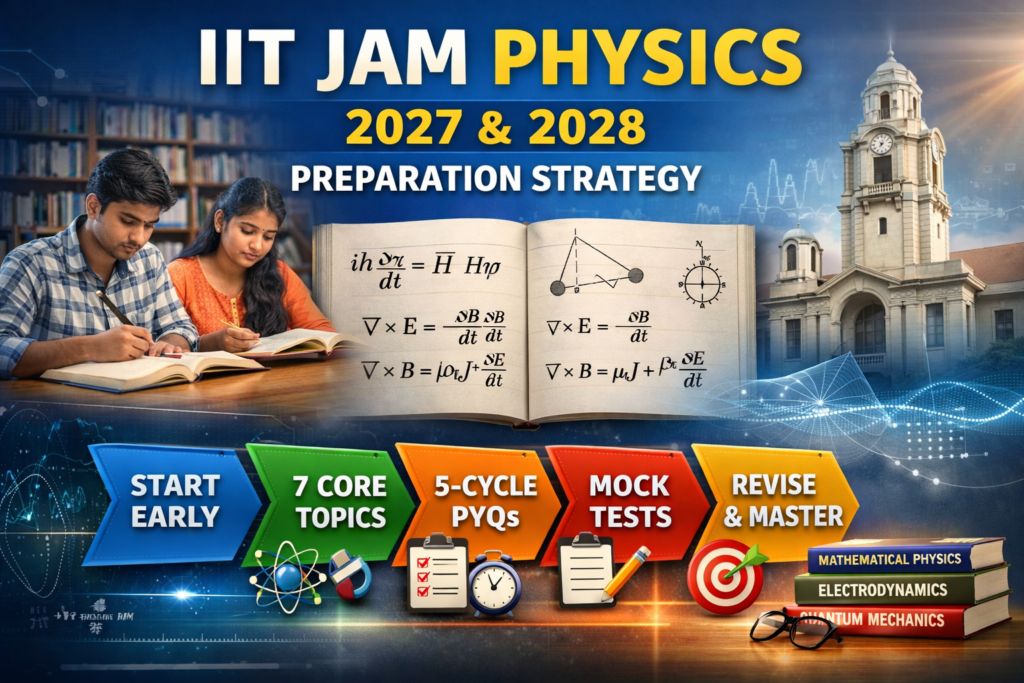
Updated October 2026: JAM 2027 is in February 2027, so 2027 aspirants now have about four months. If that is you, follow the compressed plan below and our 60-day strategy. However, if you are aiming for JAM 2028, you have about 16 months, which is ideal for the full four-phase plan. Check official notices on the JAM 2027 website.
What the IIT JAM Physics Exam Really Tests
Before you plan, be clear about what the IIT JAM Physics exam measures. It is not a recall test. It does not ask you to repeat facts or apply memorised formulas to familiar problems. Instead, it asks you to use physics on problems you have never seen. You do this under time pressure, across three question types, with rules that punish guessing and reward precision.
In particular, the exam rewards:
- Clear concepts: knowing the physics behind a problem, not just the steps for a familiar version.
- Fluent maths: doing multi-step calculations correctly under time pressure, with care for units.
- Physical reasoning: turning a physical situation into maths, and then reading the answer physically.
- Flexibility: handling new question shapes with strong basics, not memorised templates.
So this tells you exactly what your prep must build. Not recognition, but understanding. Not speed, but accuracy. And not coverage, but depth.
How to Prepare for the IIT JAM Physics Exam: The Long-Term Framework
The most reliable IIT JAM Physics exam prep follows four phases across your full window. For a JAM 2028 aspirant in early BSc, that can be 16 months or more. Each phase has its own purpose. So rushing one phase to reach the next is a common and costly mistake.
Phase 1: Build the Foundation (Months 1 to 4)
Goal: build the maths and mechanics base that every later topic needs.
Topics: Mathematical Physics (linear algebra, vector calculus, complex analysis, differential equations and Fourier series) and Classical Mechanics (Newton’s laws, central forces, the Lagrangian, oscillations and rotation).
How to study:
- Work through standard books, such as Mary L. Boas for maths and Kleppner and Kolenkow for Mechanics. Also, solve each example yourself before you check the answer.
- Derive key results from first principles. Then, at the end of each chapter, re-derive them from memory.
- Start PYQs on each topic as soon as you finish it. In other words, do not wait for the whole syllabus.
- Finally, test yourself on 8 to 10 unseen problems before you move to the next topic.
Why it matters most: maths is the language of every other topic. Meanwhile, Mechanics builds the physical sense that makes advanced topics easier. So weak basics here cause problems in every later phase.
Phase 2: Core Physics in Depth (Months 4 to 9)
Goal: build deep, exam-level understanding of high-mark topics that need Phase 1.
Topics: Electrodynamics (Griffiths), Quantum Mechanics (Griffiths) and Thermodynamics and Statistical Mechanics (Reif).
How to study:
- Learn Electrodynamics and Quantum Mechanics from standard books like Griffiths, not from short notes that skip the physics.
- Also, solve Griffiths problems actively, since they build exactly the understanding JAM tests.
- For Thermodynamics, build physical sense alongside the maths. After all, JAM often asks what entropy or free energy means, not just their formulas.
- Keep up weekly PYQs. By now, aim for 2 to 3 topic-wise PYQ sets a week.
Phase 3: High-Yield Completion (Months 9 to 13)
Goal: finish the syllabus, with extra focus on Solid State Physics and Electronics. Then tie all topics together through mixed problem solving.
Topics: Solid State Physics and Electronics (the largest group at 19 to 20%), Oscillations, Waves and Optics, and Modern Physics.
How to study:
- Treat Solid State and Electronics as a priority. Give it 4 to 6 focused weeks, since crystals, bands, devices, logic and op-amps all appear often.
- Prepare Modern Physics to calculation depth. In fact, the Bohr model, Compton scattering, decay law and Lorentz transforms often appear as NAT questions.
- Start subject-level tests that mix topics. This builds the switching skill the real paper needs.
- Finally, take your first full-length mock by the end of this phase.
Phase 4: Mocks, Error Fixing and Final Prep (Months 13 to 18)
Goal: turn prep into exam performance through mocks, error review and exam-day skill.
- Take one full mock a week under real conditions: 3 hours, no breaks and a fixed section plan.
- After each mock, spend 2 to 3 hours on error review. Sort every wrong answer as a concept gap, a calculation slip, a misread or a negative-marking error. Then fix it before the next mock.
- Next, revise only the topics where mocks show repeated gaps. This beats general revision of topics you already know.
- In the final week, learn nothing new. Instead, do light formula review and one NAT session, and get ready mentally.
For the last stretch, see our 60-day IIT JAM strategy and the final 7-day plan.
IIT JAM Physics Exam Roadmap by Stage
| Aspirant | Current Stage | When to Start | Best Approach |
|---|---|---|---|
| JAM 2027 | BSc 3rd year (now) | Right away | Compressed 4-month plan: top topics first, PYQs and weekly mocks |
| JAM 2028 | BSc 2nd year (now) | Now | The full four-phase plan, with time for depth and revision |
| JAM 2028 | BSc 1st year | After settling into college | Start maths alongside coursework, and build slowly but steadily |
| Working or MSc student | Any stage | Now | Evening and weekend programme (CPOP), planned around your free hours |
The Research Mindset: Why It Changes How You Prepare
At Pravegaa, we teach the IIT JAM Physics exam as a research entrance, not as a typical coaching exam. This matters in practice, not just in theory.
A researcher asks: What is happening physically? Which principles apply? What does my answer mean? Can I check limiting cases? By contrast, an exam-only student asks: Which formula fits? Have I seen this type? What is the fastest path?
The IIT JAM Physics exam is built to tell these two mindsets apart. Examiners frame familiar ideas in new ways, combine two principles you rarely see together, and test the meaning of a result, not just the result. So building a research mindset means you should:
- always ask why a formula is true, not just what it says,
- also check limiting cases and your intuition against the maths,
- then link each new topic to the ones you have already studied, and
- finally, read PYQs as the examiner’s message about how topics are tested.
PYQ Strategy: The 5-Cycle Approach
Past questions are the most important resource for the IIT JAM Physics exam, more than any book, lecture series or notes. Indeed, they show you the depth needed and how each topic is tested. So use them in five cycles:
- Topic-wise PYQs (from Month 1): after each topic, solve every PYQ on it from 2016 to 2026.
- Error review: next, for every PYQ you got wrong or felt unsure about, find the exact gap and fix it.
- Mixed PYQ practice (Months 8 to 12): then solve full past papers in one sitting, to build the habit of moving across topics.
- Timed full papers (Months 13 to 16): after that, solve the last 5 years under strict exam conditions, like mock exams.
- Final-week calibration: finally, solve only NAT questions from the last 2 to 3 years, to keep your accuracy sharp.
You can download all IIT JAM Physics PYQ papers from 2016 to 2026 for free.
How to Sync IIT JAM Prep with BSc Coursework
Many 2027 and 2028 aspirants worry about managing the IIT JAM Physics exam with their BSc. The short answer: do not treat them as separate. Instead, sync them.
The IIT JAM Physics syllabus is mostly the BSc Physics Honours course, with the same core topics at a similar depth. So when your semester covers Electrodynamics, deepen Electrodynamics for JAM. And when your course reaches Quantum Mechanics, step up your QM prep. This way, two demands become one effort that helps both.
Here is how to sync them:
- Use JAM-level books, such as Griffiths for EM and QM and Boas for maths, as your main references, not just college notes. In fact, the extra depth will lift your semester marks too.
- Also, solve JAM PYQs on each topic while your college covers it. That shows you the exam standard right away.
- During college exam weeks, study less for JAM, and then catch up in the next weeks.
- Finally, use summer breaks for topics your college has not covered yet, especially Solid State and Electronics.
If you study at Delhi University or in the NCR, our College Parallel Hybrid Program (DU–NCR) is built for this, with offline weekend sessions and online weekday evenings. Elsewhere in India, our CPOP evening and weekend online programme gives the same structure fully online.
The Role of Mentorship in IIT JAM Physics Exam Prep
Self-study has a well-known weak spot. Hidden concept gaps grow quietly for months. Then they show up as repeated mock errors across many topics. By then, they are hard to trace, because they have spread.
A mentor prevents this. Not by teaching you more content, but by spotting errors early, adjusting your plan when it drifts and giving honest feedback on where you stand. In particular, a good mentor gives three things self-study cannot:
- Root-cause diagnosis: when you get a QM problem wrong, a mentor can tell if the issue is QM, maths, calculation habits or reading the question. Then each one gets a different fix.
- Plan reviews: at 6, 9 and 12 months, a mentor reviews your plan using real mock data, so you do not run on autopilot.
- Support in hard weeks: when a topic will not click, most students either push on badly or skip it. A mentor, however, finds the exact block and clears it.
Explore our IIT JAM Physics Online Live Course for structured prep with built-in mentorship. Or book a free demo class to see our teaching first.
Topic Priority Order for the IIT JAM Physics Exam
| Priority | Topic | Main Book | Weight | Why |
|---|---|---|---|---|
| 1 | Mathematical Physics | Mary L. Boas | 15 to 16% | The base for every other topic |
| 2 | Solid State and Electronics | S.O. Pillai and Thomas Floyd | 19 to 20% | Highest weight, yet often skipped |
| 3 | Electrodynamics | Griffiths | 13 to 15% | High marks and a key rank separator |
| 4 | Classical Mechanics | Kleppner and Kolenkow | 10 to 12% | Builds physical sense for QM and EM |
| 5 | Quantum Mechanics | Griffiths and Zettili | 8 to 10% | Needs maths and Mechanics first |
| 6 | Thermodynamics and Stat Mech | F. Reif | 10 to 12% | NAT-heavy, so calculation depth matters |
| 7 | Oscillations, Waves and Optics | N.K. Bajaj and Ajoy Ghatak | 12 to 14% | A scoring section |
| 8 | Modern Physics | H.C. Verma or Arthur Beiser | 8 to 10% | Growing, with calculation-heavy NATs |
For a full data-based weightage analysis, read our post on the JAM Physics syllabus through data. For the unit-wise syllabus, visit our IIT JAM syllabus page.
FAQs: How to Prepare for the IIT JAM Physics Exam
How early should I start preparing?
For JAM 2028, the best time to start is your BSc 1st or 2nd year. That gives you the ideal 16+ months. For JAM 2027, start right away and use a compressed plan. Starting early allows deep prep without stress. Later starts, however, need more daily effort and sharper topic choices. In short, there is no such thing as starting too early.
How many hours a day should I study?
If you study alongside college, 3 to 4 focused hours on weekdays plus 6 to 8 on weekends works well. If you prepare full time, aim for 8 to 10 focused hours a day. Still, focus matters more than hours. After all, passive reading or watching brings far less progress than solving problems on your own.
Should I join coaching or study on my own?
Both can work, but they give different results. Disciplined self-study with good books and steady PYQs can get you qualified. On the other hand, structured coaching with concept-first teaching, mentorship and regular tests more often leads to top ranks. The main risk of self-study is hidden concept gaps. So if a top IIT is your goal, structured prep with accountability helps a lot.
Is one year enough?
Yes. One year of structured prep is enough for a good rank for most students with a solid BSc base. First, do maths and Mechanics in months 1 to 3. Then do Electrodynamics, QM and Thermodynamics in months 3 to 7. Next, cover Solid State and the rest in months 7 to 10. Finally, spend the last 2 months on mocks and error review. If your base is weaker, you may need 15 to 18 months.
What is the biggest prep mistake?
Treating the syllabus as a reading list instead of a problem-solving course. The exam does not check whether you have seen each topic. Rather, it checks whether you can solve problems with it on your own. Students who spend 80% of their time reading and 20% solving usually underperform. So flip the ratio: aim for 60 to 70% problem solving and 30 to 40% learning and review.
How do I know if my prep is on track?
Use three checks. First, after each topic, try 10 unseen PYQs without help. If you get fewer than 6 or 7 right, that topic needs more work. Second, take a full mock every 6 to 8 weeks and track the trend. Third, use the IIT JAM Physics Test Series for an All India Rank, which gives you an honest picture of where you stand.
Start Your IIT JAM Physics Exam Prep with Pravegaa
15+ years of building JAM rankers, including several AIR 1 results, with this exact long-term approach.
Call: 8920759559 · 8076563184